

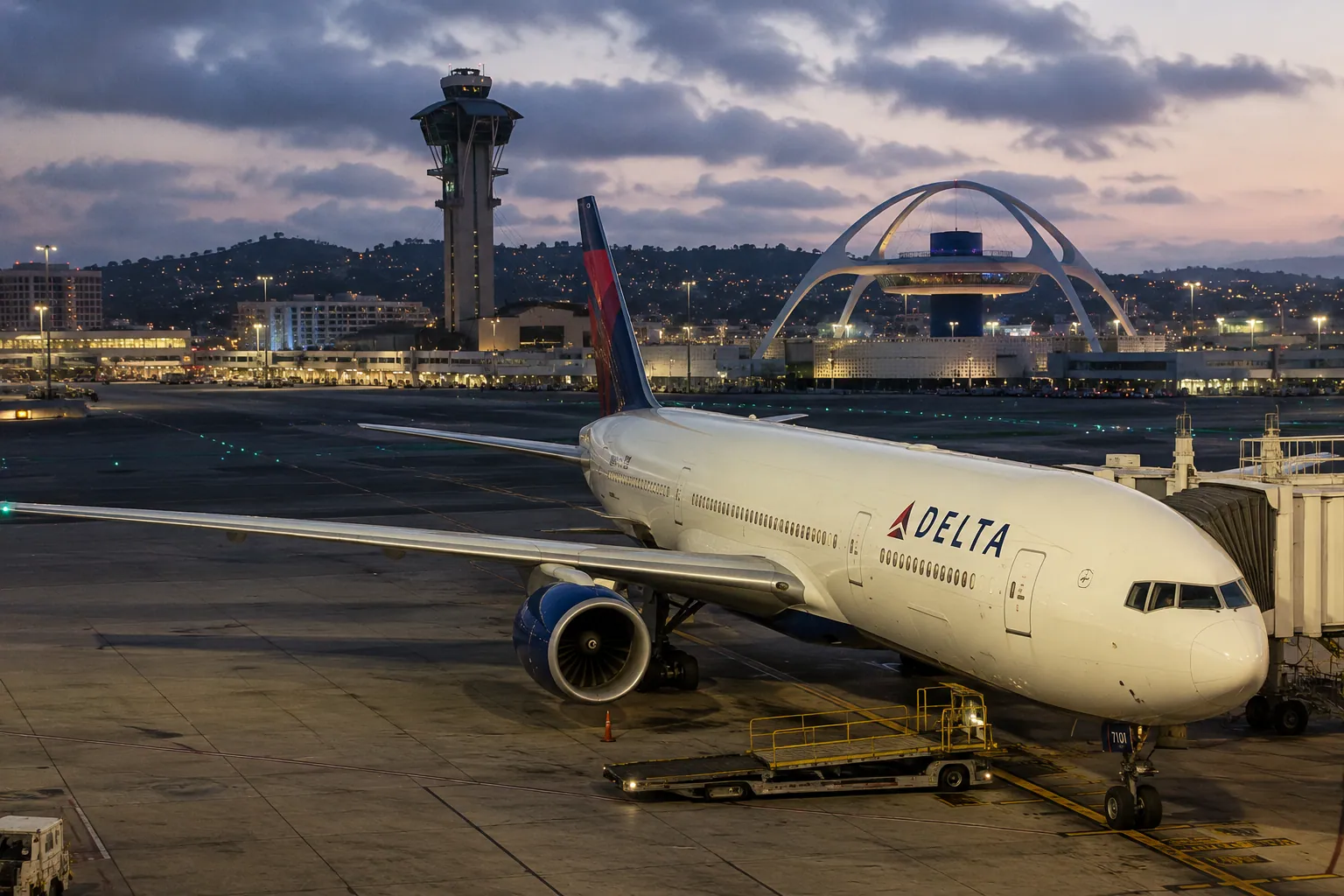
Delta flight dl275 diverted lax became a highly searched aviation topic after reports said a Delta Air Lines long-haul flight from Detroit to Tokyo Haneda turned around and landed at Los Angeles International Airport. For passengers, families, and aviation watchers, the biggest questions were simple: What happened to Delta Flight DL275? Why did it divert to LAX? Was it an emergency landing? And what happens to passengers after a flight diversion?
According to AIRLIVE, Delta Flight DL275 departed Detroit for a planned 13-hour flight to Tokyo Haneda Airport, then turned around while flying over the Bering Sea for a reason that was still unknown in that report. The aircraft was listed as an Airbus A350-900 / A350-941, registration N508DN, and AIRLIVE reported that it flew about 5 hours before landing at LAX on runway 06R.
This article explains the Delta DL275 diversion in a clear, safety-focused way, while separating reported facts from unverified claims.
Quick Facts About Delta Flight DL275 Diverted to LAX
| Fact | Detail |
| Flight number | Delta Flight DL275 / DAL275 |
| Airline | Delta Air Lines |
| Reported route | Detroit / DTW to Tokyo Haneda / HND |
| Diversion airport | Los Angeles International Airport / LAX |
| Aircraft reported | Airbus A350-900 / Airbus A350-941 |
| Aircraft registration reported | N508DN |
| Reported turn area | Bering Sea / North Pacific region |
| Reported landing runway | Runway 06R |
| Main public question | Why did Delta Flight DL275 divert to LAX? |
The most important point is this: a flight diversion does not automatically mean a crash, disaster, or confirmed emergency. In many cases, a diversion is a precautionary safety decision made by pilots, dispatchers, air traffic control, and airline operations teams.
What Happened to Delta Flight DL275?
The reported Delta DL275 Detroit to Tokyo flight diversion involved a long-haul international route that did not continue to its planned destination. AIRLIVE reported that Delta Flight DL275 left Detroit from gate A46 for Tokyo Haneda and later turned around while over the Bering Sea. The report also said the aircraft then flew for about 5 hours to reach Los Angeles Airport.
That basic sequence explains why people searched phrases like “Delta flight DL275 diverted to LAX,” “DL275 diverted to LAX,” “Delta flight to Japan diverted to LAX,” and “what happened to Delta Flight DL275.”
However, the exact reason for the diversion should be handled carefully. Some online discussions and secondary articles mention possible technical concerns, including an engine anti-ice system or another mechanical issue, but not every claim online is an official confirmation. Unless Delta Air Lines, LAX, the FAA, or another official aviation authority confirms the cause, the safest wording is that DL275 diverted after a reported in-flight operational or technical concern.
That distinction matters. Aviation stories often spread quickly through flight tracker screenshots, Reddit threads, X posts, and aviation blogs. A tracker can show that an aircraft changed route, but it does not always explain why the crew made that decision.
Timeline of the Reported DL275 Diversion
A simple timeline makes the event easier to understand:
- Departure from Detroit: DL275 reportedly departed Detroit Metropolitan Wayne County Airport for Tokyo Haneda Airport.
- Long-haul flight begins: The aircraft entered its trans-Pacific route toward Japan.
- Turnaround near the Bering Sea: AIRLIVE reported that the crew decided to turn around while flying over the Bering Sea.
- Diversion to Los Angeles: Instead of continuing to Tokyo or returning directly to Detroit, the aircraft headed toward LAX.
- Landing at LAX: The Airbus A350-900, registration N508DN, reportedly landed on runway 06R.
- Passenger handling begins: After a diverted international flight lands, airline teams usually manage rebooking, baggage, hotel support, meal vouchers, onward flights, and customer service communication.
This timeline also helps answer a common search query: “Delta flight DL275 flew 5 hours to divert to LAX.” The long distance does not necessarily mean the crew was lost or confused. On oceanic routes, the best diversion airport may depend on fuel reserves, airport capability, maintenance support, weather conditions, crew duty-time limits, and passenger handling facilities.
Why Was Delta Flight DL275 Diverted to LAX?
The short answer is: the publicly confirmed reason is not fully clear from the available reports. AIRLIVE said the crew turned around “for a reason still unknown” in its report.
That said, long-haul flights usually divert for one of several broad reasons: a technical issue, mechanical concern, medical emergency, weather condition, air traffic control restriction, airport closure, or another operational reason. For DL275, many users searched for “Delta Flight DL275 diverted LAX reason,” “Delta DL275 diversion reason,” and “Delta flight DL275 technical issue.”
Some online articles and discussions have connected the diversion to a possible engine anti-ice system concern. An engine anti-ice system helps protect parts of the engine from ice buildup in certain atmospheric conditions. If a crew receives an in-flight warning or abnormal indication involving such a system, they may decide that continuing across remote oceanic airspace is not the best option.
Still, it is important not to overstate that point. Without an official Delta statement, FAA incident report, or NTSB report, the article should not claim the anti-ice issue as proven. A responsible explanation would be:
Reported aviation discussions have mentioned a possible technical or anti-ice concern, but the exact cause should be treated as unconfirmed unless Delta or an aviation authority confirms it.
That wording protects the article from misinformation while still satisfying search intent.
Was Delta Flight DL275 an Emergency Landing?
Many people search “was Delta Flight DL275 an emergency landing” because the word diverted sounds alarming. But a diversion is not always the same as a dramatic emergency landing.
A flight diversion means the aircraft landed somewhere other than its planned destination. An emergency landing usually means the crew declared or handled an urgent situation that required priority attention. A precautionary landing is a safety-first decision where the crew chooses to land before a problem becomes more serious.
For Delta Flight DL275 diverted LAX, the safer language is reported diversion or precautionary diversion, unless official records confirm that an emergency was declared. A diverted flight can still land normally, taxi to a gate, and allow passengers to deplane safely.
In aviation, conservative decisions are a strength, not a weakness. Pilots are trained to avoid unnecessary risk. If an aircraft system, weather factor, medical issue, or operational concern makes the planned route less suitable, the crew may choose an alternate airport with better support.
So, does a diverted flight mean the plane was unsafe? Not necessarily. It often means the crew used safety protocols, aircraft checklist procedures, air traffic control coordination, and airline dispatch support to reduce risk.
Why Was LAX Chosen as the Diversion Airport?
A major question is why LAX was chosen instead of continuing to Tokyo Haneda, returning to Detroit, or diverting to another airport such as Anchorage or Seattle.
There may be several practical reasons. Los Angeles International Airport is one of the largest international airports in the United States. It has long runways, wide-body aircraft handling, emergency services, international passenger facilities, customs support, airline ground teams, and maintenance resources. For an Airbus A350 on a trans-Pacific route, those things matter.
A diversion airport is not chosen only by looking at the closest dot on a map. The crew and airline operations team may consider:
- Aircraft condition
- Fuel status and fuel reserves
- Weather conditions
- Runway length
- Maintenance support
- Passenger rebooking options
- Crew scheduling
- Customs and immigration processing
- Emergency response capability
- Availability of replacement aircraft or parts
That is why LAX diversion airport is a strong keyword and a useful article section. It answers a real user question competitors often do not explain deeply enough.
If the flight was over the North Pacific or near the Bering Sea, the best airport may have depended on operational calculations such as alternate airport planning, oceanic diversion planning, and the aircraft’s equal time point. In simple words, pilots and dispatchers look for the safest and most practical place to land, not just the nearest airport.
Why Not Continue to Tokyo or Return to Detroit?
This is one of the biggest content gaps around the keyword “delta flight dl275 diverted lax.” Many readers wonder: if the flight was going to Japan, why not continue to Japan? If it had already left Detroit, why not go back to Detroit?
The answer depends on the situation. If the crew detects a possible technical concern, continuing across remote oceanic airspace may not be ideal. If the aircraft has already flown several hours, returning to Detroit may also be less practical than heading to a major West Coast airport.
For trans-Pacific flights, the decision is not emotional. It is based on fuel reserves, route distance, weather, airport suitability, aircraft maintenance, crew duty-time limits, and passenger-care logistics. A major airport like LAX may offer better support than a smaller alternate airport, especially for a wide-body international aircraft.
This is where terms like ETOPS, extended-range twin-engine operations, and oceanic diversion planning become relevant. Most passengers do not need the technical details, but the basic idea is simple: modern long-haul flights are planned with alternate airports and safety margins in mind.
So, why not continue to Tokyo? Possibly because the crew decided landing earlier at a suitable airport was safer or more practical. Why not return to Detroit? Possibly because LAX offered better operational support based on the aircraft’s position and needs. Without official confirmation, those remain informed explanations rather than confirmed reasons.
Aircraft and Route Details: DL275, Airbus A350, DTW to HND
DL275 / DAL275 is commonly searched as a Delta Air Lines flight tracking query. FlightAware’s page for DL275 (DAL275) is built around flight tracking and history, and FlightAware describes its platform as offering real-time, historical, and predictive flight insights for the aviation industry.
AIRLIVE reported the aircraft involved in the diversion story as an Airbus A350-941, with data tags including DL, DL275, LAX, and N508DN. It also described the aircraft as an Airbus A350-900 with registration N508DN.
The Airbus A350-900 is a long-haul wide-body aircraft often used on international routes. In the context of this article, the key point is not the full technical specification. The important SEO and reader-friendly facts are:
- Flight: Delta Flight DL275 / DAL275
- Route: Detroit to Tokyo Haneda
- Aircraft reported: Airbus A350-900 / Airbus A350-941
- Registration reported: N508DN
- Diversion airport: Los Angeles International Airport
- Reported landing runway: Runway 06R
These details help readers searching “Delta DL275 Airbus A350 diversion,” “DL275 flight tracking,” and “Delta DL275 current flight status.”
What Happens to Passengers After a Flight Diversion?
When a flight diverts, passengers usually want practical answers quickly. They want to know where they are, whether they can leave the aircraft, what happens to baggage, whether they will be rebooked, and whether the airline will provide meals or hotel accommodation.
After a Delta flight diversion, the airline’s airport and customer service teams typically work through several steps. Passengers may receive a captain announcement, gate instructions, rebooking updates, and information through the Delta app, display boards, text alerts, or customer service desks.
For an international flight like Detroit to Tokyo Haneda, passenger handling can be more complicated. Depending on the situation, passengers may need help with immigration processing, baggage handling, alternate flights, hotel accommodation, meal vouchers, and onward travel.
A smart passenger should keep:
- Boarding pass
- Booking confirmation
- Delay or diversion notifications
- Hotel receipts
- Meal receipts
- Ground transportation invoices
- Baggage claim information
- Screenshots of flight status changes
This is especially useful if the traveler later files a reimbursement request, travel insurance claim, or credit card trip delay insurance claim.
Passenger Rights, Refunds, and Compensation After a Delta Diversion
Many users search “Delta DL275 passenger compensation” or “can you seek compensation after a Delta flight diversion.” The answer depends on the cause, delay length, destination laws, ticket conditions, and airline policy.
The U.S. Department of Transportation’s customer service dashboard lists airline commitments for controllable cancellations and controllable delays, including rebooking, meals, hotel accommodation, and ground transportation in certain situations. The DOT page also says airlines must adhere to their commitments and that passengers can file a DOT complaint if they are not satisfied after contacting the airline.
For Delta specifically, the DOT dashboard shows that Delta commits to meal or meal-cash vouchers when a controllable cancellation causes a passenger to wait 3 hours or more for a new flight, and it also lists hotel and ground transportation commitments for overnight controllable cancellations. For controllable delays, the dashboard also lists meal vouchers after a 3-hour wait and hotel/ground transportation commitments for overnight delays.
Delta’s U.S. Contract of Carriage also matters. It says Delta has no liability for certain flight cancellations, diversions, or delays caused by force majeure, including weather, government requirements, labor issues, shortages, or other conditions beyond Delta’s control. It also says that, outside force majeure, Delta may provide amenities when travel is interrupted for more than 4 hours after scheduled departure due to cancellation or delay on the date of travel.
In simple terms: passengers should not assume automatic cash compensation. But they should ask Delta about rebooking, meal vouchers, hotel accommodation, ground transportation, refund eligibility, and reimbursement for reasonable expenses.
How to Track Delta Flight DL275 Live
Some users are not looking for the full story. They simply want DL275 flight tracking, DAL275 flight status, or FlightAware DL275 flight history.
To track Delta Flight DL275 live, passengers can check:
- Delta’s official website or Fly Delta app
- FlightAware DL275 / DAL275
- FlightStats DL275
- Flightradar24 DL275
- PlaneFinder DL275
- Trip.com DL275 status
- Airport departure and arrival boards
FlightAware includes tools and categories such as flight tracking, airport delays, cancellations, ADS-B, Flight Finder, and aircraft details. Its DL275 page is designed for tracking and flight history rather than a narrative news explanation.
For the most reliable result, compare a flight tracker with the airline’s own status page. Flight trackers are useful for route and timing, but the airline is usually the best source for passenger instructions, rebooking options, baggage updates, and customer-care decisions.
How to Verify the DL275 Diversion and Avoid Misinformation
The keyword “delta flight dl275 diverted lax” is also a good example of how aviation stories spread online. A flight path appears on a tracker, aviation accounts share screenshots, blogs publish summaries, and then readers search for a clear explanation.
To verify a story like this, check multiple source types:
First, look at flight-tracking data such as FlightAware, Flightradar24, or FlightStats. These can help confirm whether the aircraft changed route, landed at a different airport, or arrived late.
Second, look for an official Delta statement, LAX official update, FAA incident report, or NTSB report if the situation involved a reportable incident. If none exists, use cautious language.
Third, separate confirmed basics from speculation. For example, AIRLIVE reported the route, aircraft, registration, approximate timing, and landing runway, while also saying the reason was still unknown. That is different from claiming a specific mechanical fault was officially confirmed.
The best article should avoid dramatic phrases like “near disaster” unless officially supported. Better wording includes “reported diversion,” “precautionary landing,” “technical concern,” “safety-related decision,” and “available flight-tracking information.”
What Most Reports Miss About the Delta DL275 Diversion
Most short competitor articles cover the basic event, but they often miss the deeper questions readers actually care about.
The first missing angle is why LAX may have made operational sense. A diversion is not just about geography. It involves airport capability, aircraft support, weather, crew duty time, fuel, passenger processing, and maintenance.
The second missing angle is confirmed reports vs speculation. Readers should know whether a detail came from an official airline statement, a flight tracker, an aviation blog, or a social media post. That distinction builds trust.
The third missing angle is passenger rights by cause of disruption. A technical issue, weather event, medical emergency, aircraft recall, or air traffic restriction can lead to different customer service outcomes. That is why travelers should check the DOT airline customer service dashboard, Delta contract of carriage, travel insurance terms, and credit card trip delay coverage.
The fourth missing angle is what passengers should do immediately. After a diverted international flight, passengers should document expenses, save receipts, monitor flight status, ask for written rebooking details, check baggage status, and contact customer care after the trip if needed.
This approach makes the article more useful than a basic news recap.
What This Diversion Shows About Aviation Safety
The Delta Flight DL275 diverted LAX story shows why modern aviation is built around layered safety. A crew does not need to wait for a situation to become dangerous before taking action. If something does not look right, the safer choice may be to land at a major airport with better support.
Aviation safety depends on trained pilots, flight crew, airline dispatchers, air traffic control, maintenance teams, airport emergency teams, and detailed procedures. Aircraft like the Airbus A350 also have monitoring systems and checklists designed to help crews make conservative decisions.
For passengers, the important lesson is this: a diversion can be frustrating, but it can also be evidence that the safety system is working. Missed connections, hotel stays, and long delays are stressful, but they are better than continuing a route when the crew believes a safer option exists.
FAQs About Delta Flight DL275 Diverted LAX
Why was Delta Flight DL275 diverted to LAX?
The exact confirmed reason is not fully clear from the available public reports. AIRLIVE reported that the crew turned around while over the Bering Sea for a reason still unknown in that report. Some online discussions mention a possible technical issue, but that should be treated cautiously unless officially confirmed.
Was Delta Flight DL275 an emergency landing?
Not necessarily. A diversion does not automatically mean an emergency landing. It may be a precautionary landing or safety-related operational decision.
Where was Delta Flight DL275 originally going?
The reported route was Detroit / DTW to Tokyo Haneda / HND. AIRLIVE described it as a Delta Air Lines flight from Detroit to Tokyo Haneda.
What aircraft was used on Delta DL275?
AIRLIVE listed the aircraft as an Airbus A350-941 and also described it as an Airbus A350-900, registration N508DN.
Can passengers get compensation after a Delta flight diversion?
It depends on the cause and delay details. DOT’s dashboard lists customer-service commitments for controllable delays and cancellations, while Delta’s Contract of Carriage limits liability for force majeure events.
How can I track Delta Flight DL275 live?
Use the Delta app, Delta’s website, FlightAware DL275, FlightStats, Flightradar24, PlaneFinder, or airport status boards. FlightAware provides real-time, historical, and predictive flight tracking information.
Conclusion
The Delta Flight DL275 diverted LAX story is best understood as a reported long-haul flight diversion involving a Delta Air Lines Airbus A350 traveling from Detroit to Tokyo Haneda and landing at Los Angeles International Airport. The available AIRLIVE report confirms key details such as the route, aircraft type, registration N508DN, approximate 5-hour diversion flight, and runway 06R landing, while also saying the reason was still unknown.
For readers, the most important takeaway is simple: a diversion is not automatically a disaster. It is often a safety-first decision. Passengers should verify updates through official sources, track the flight through reliable tools, keep receipts, and check Delta and DOT guidance for rebooking, hotel, meal, refund, or reimbursement options.
Disclaimer: This article is for general informational purposes only and is based on publicly reported details available at the time of writing. Flight situations, airline policies, passenger rights, and official findings may change, so always verify updates with Delta or authorities.