

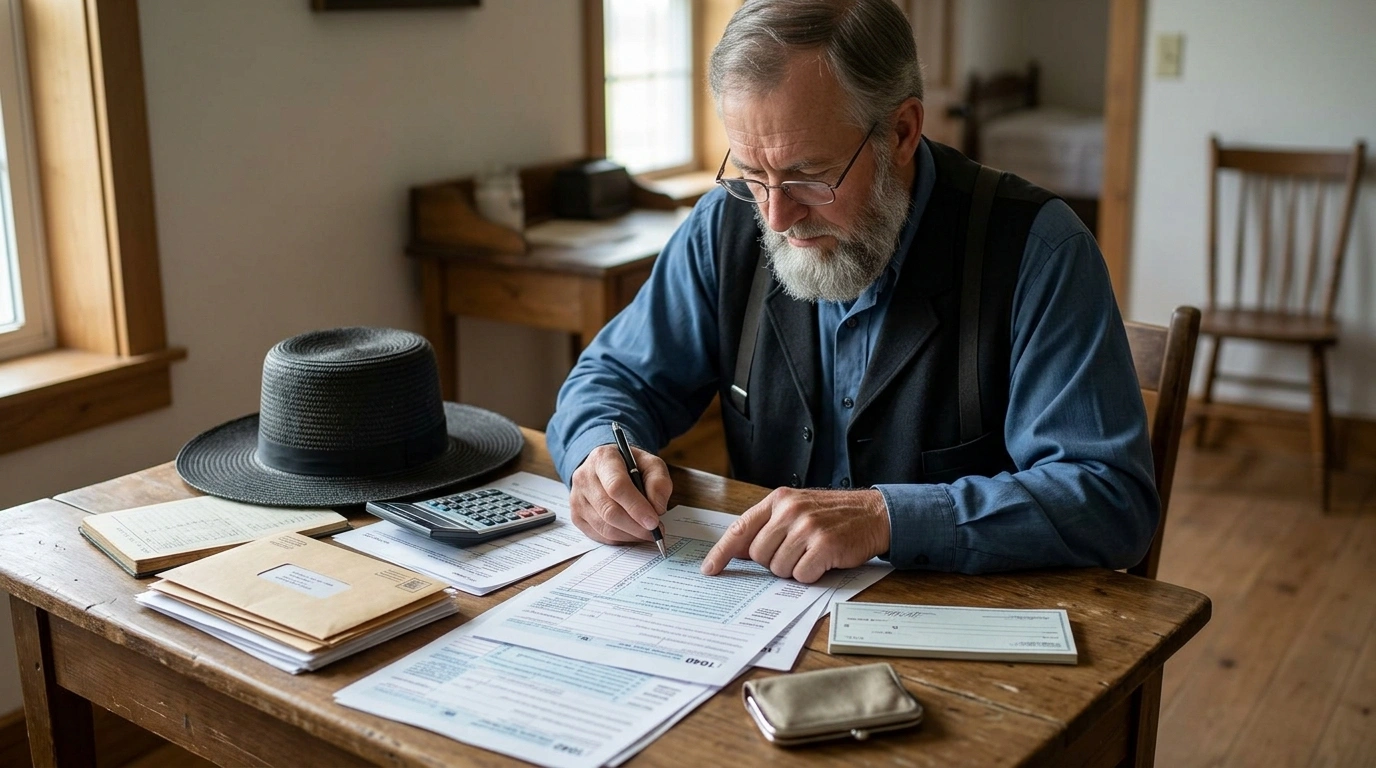
Yes — in most cases, they do. That is the short answer, and it clears up the biggest myth right away. Amish households generally pay federal income taxes, state income taxes, sales taxes, real estate or property taxes, and school taxes. Where people get confused is the narrow religious exemption tied to Social Security and Medicare taxes. Under U.S. law, members of certain recognized religious groups, including many Amish and Mennonites, may apply for that exemption through Form 4029, but the exemption does not apply to federal income tax.
That distinction matters because a lot of online discussion treats “Amish tax exemption” as if it means all taxes disappear. That is not how the system works. The real issue is much narrower: some qualifying members of certain religious sects can be exempt from paying into Social Security and Medicare, and in exchange they waive rights to those benefits. Everything else still has to be understood tax by tax, not myth by myth.
So if you are searching what taxes do the Amish pay, what taxes are the Amish exempt from, or do Amish pay federal income tax, this guide gives the full answer in plain English.
What Taxes Do the Amish Pay?
The easiest way to understand Amish taxes is to start with the taxes they usually do pay. Authoritative Amish studies material says Amish people do pay state and federal income taxes, sales taxes, real estate taxes, and public school taxes. That alone answers most of the search intent behind do the Amish pay taxes yes or no: yes, they do.
In practical terms, that means an Amish family that earns taxable income is generally still subject to federal income tax and often state income tax. If they buy goods in a state with sales tax, they generally pay sales tax like everyone else. If they own land, a home, a farm, or another taxable property, they generally pay property tax or real property tax. Many Amish families also pay public school taxes, even though they typically educate their children in Amish or private schools rather than public schools. Some educational sources note that many Amish effectively pay school taxes twice by supporting both public schools through taxes and their own private educational systems directly.
This is where the common rumor breaks down. People hear about a religious exemption and assume it covers everything from income tax to county taxes to estate tax. But the broad claim that Amish people are simply “tax-exempt” is inaccurate. They are part of the tax system, and the only major carveout most people are referring to is the one related to Social Security and Medicare taxes.
To make that clearer, here is the simplest possible breakdown:
| Tax type | Do Amish usually pay it? | Important note |
| Federal income tax | Yes | Form 4029 does not exempt this tax. |
| State income tax | Usually yes | Depends on state rules, but no blanket Amish exemption. |
| Sales tax | Yes | Generally paid like other consumers. |
| Property / real estate tax | Yes | Applies to owned land and taxable property. |
| Public school taxes | Yes | Often paid even when Amish children attend private Amish schools. |
| Social Security tax | Sometimes exempt | Only for qualifying members with approved exemption. |
| Medicare tax | Sometimes exempt | Same exemption framework as Social Security. |
The table helps answer both what taxes do the Amish pay and what taxes are the Amish exempt from without oversimplifying the issue.
Why Do Some Amish Not Pay Social Security and Medicare Taxes?
The Amish exception exists because of a specific religious objection, not because Congress decided one group should stop paying taxes in general. The Social Security Administration says members of certain religious groups, including the Amish and Mennonites, may be exempt if they meet legal requirements. Those requirements are tied to long-standing religious beliefs against insurance-style systems and a commitment that the religious community will care for its own members.
That point is important for SEO and for accuracy. The Amish objection is usually described as a religious objection to public insurance. Social Security and Medicare are treated in this context as public insurance programs. The law allows a narrow exemption for members of recognized religious sects that oppose accepting those benefits and that make provision for their dependent members. In other words, the exemption is connected to a whole belief system and community structure, not just to personal preference or a desire to lower taxes.
This is also why the exemption comes with a tradeoff. If someone has an approved exemption, the benefit waiver matters. The person is not just avoiding the tax; they are also giving up the right to receive the associated Social Security or Medicare benefits tied to that exemption. That is why phrases like waiver of benefits, recognized religious sect, and members of certain religious groups are so important in an article like this. They explain the legal logic behind the rule.
So, when people ask are Amish exempt from Social Security tax, the accurate answer is: some qualifying members are, but only if they meet the religious-group requirements and complete the official process.
What Is Form 4029, and Who Qualifies for It?
Form 4029 is the key document behind the Amish tax exemption question. The IRS says members of recognized religious groups file Form 4029 to apply for exemption from Social Security and Medicare taxes. The form itself also states a crucial warning in plain language: approval exempts the taxpayer from Social Security and Medicare taxes only; it does not exempt them from federal income tax.
That one sentence from the form clears up most of the internet confusion.
The Social Security Administration adds that members of certain religious groups, including Amish and Mennonites, may qualify only if they meet specific conditions. The exemption is not automatic. The person must belong to a qualifying group, object to insurance benefits for religious reasons, and go through the filing and approval process. SSA policy materials also note that eligibility involves an IRS-4029 and joint certification by SSA and IRS.
This is why how do Amish qualify for tax exemption is a better question than simply do the Amish pay taxes. The real legal answer depends on qualification. A person does not become exempt because they say they are Amish for tax purposes. They have to satisfy the statutory requirements connected to the religious sect, and the exemption is granted only after approval.
If you want the simplest explanation of Form 4029, it is this:
Form 4029 is the application used by qualifying members of certain religious groups to request exemption from Social Security and Medicare taxes, while waiving rights to those benefits.
That is the heart of the issue, and it is one of the biggest content gaps many competitor pages do not explain clearly enough.
Do Amish Still Pay Federal Income Tax?
This is the question many readers really mean when they search do Amish pay taxes.
The answer is yes. Even if a qualifying Amish person has an approved Form 4029, the form itself says the exemption does not apply to federal income tax. That means the Social Security/Medicare exemption should never be confused with a blanket exemption from ordinary income-tax rules.
That distinction is so important that it deserves repeating in plain language: federal income tax and Social Security tax are not the same thing. Form 4029 addresses Social Security and Medicare taxes only. It does not erase the duty to report taxable income on forms like Form 1040, and it does not turn Amish households into a permanently tax-free class.
This is also where a lot of myths become easy to spot. If someone says, “The Amish do not pay taxes,” they are blending together completely different tax categories. The legally accurate version is much narrower: some Amish are exempt from Social Security and Medicare taxes after approval, but they still pay federal income tax and other common taxes.
Do Amish Pay Property, Sales, and School Taxes?
They generally do. That includes sales tax, property tax, and public school taxes. Educational and historical sources on Amish life say this clearly, and it is one of the most important myth-busting facts in the topic.
The school taxes point surprises many readers the most. Amish communities often run or support their own schools, yet many still pay taxes that support public schools. Some sources even summarize this by saying many Amish families pay school-related costs “twice” — once through taxes and again through private support of Amish education. That detail is powerful because it directly challenges the idea that Amish communities avoid the public tax system.
The same goes for real estate taxes and sales taxes. If an Amish family owns taxable land or property, those taxes generally still apply. If they purchase taxable goods, sales tax generally still applies. So if someone searches do Amish pay property tax or do Amish pay sales tax like everyone else, the answer is usually yes.
This part of the discussion is also useful because it shows how misleading the phrase Amish tax exemption can be without context. The exemption does not wipe out routine obligations attached to buying property, owning land, or living within a state and local tax structure.
Do Amish Pay Self-Employment Tax, FICA, or SECA?
This is where the topic becomes more technical, but it is also where your article can be more useful than thin competitor pages.
If an Amish person qualifies for and receives the religious exemption, the effect can apply to Social Security and Medicare taxes tied to self-employment and certain employment situations. The Form 4029 language specifically references exemption from Social Security and Medicare taxes on earnings from self-employment and from the employer’s share in qualifying circumstances.
That means users asking do self-employed Amish pay self-employment tax or do the Amish pay Social Security if they work for themselves are really asking about the relationship between the religious exemption and the taxes commonly associated with self-employment. In tax language, this often overlaps with ideas people describe using FICA and SECA. The key point is that the exemption is still tied to the approved religious-sect process; it is not a general rule for all self-employed Amish people automatically.
Things get more complicated when Amish individuals work for non-Amish employers. The Taxpayer Advocate Service has noted inequities in situations where Amish employees of non-Amish employers may have the employee portion of FICA remitted, and it has discussed proposals that would let such employees seek refunds more cleanly. That tells you two things. First, this area is more complex than the average blog post suggests. Second, self-employed vs employed Amish tax rules are not identical in practice.
So, the clean answer is this: self-employment tax, FICA, and related payroll-tax questions depend on whether the person has a valid approved exemption and on the employment arrangement. This is not the same as saying, “Amish never pay payroll-type taxes.” It is more accurate to say that qualifying Amish individuals may be exempt from Social Security and Medicare taxes under specific religious-sect rules, and that employment context can matter.
Do Amish Receive Social Security, Medicare, Unemployment, or Other Government Benefits?
Usually, the answer follows the same logic as the exemption itself. If a person receives the exemption and waives those benefits, they are generally not paying into the system and not receiving those related benefits. SSA explains that the exemption is tied to religious groups that object to such insurance benefits, and IRS/SSA materials frame Form 4029 as involving a waiver of benefits.
That is why questions like do Amish collect Social Security benefits, do Amish collect unemployment benefits, and do the Amish get Medicare matter so much in this topic cluster. The public often assumes the Amish found a way to skip paying taxes while still using government benefits. The real rule is much stricter than that. The exemption is part of a broader religious position against participating in that public insurance structure.
This also explains why so many descriptions of Amish life emphasize community support. Historically and culturally, Amish communities have been described as relying heavily on church and community support for members in need, including the elderly and vulnerable, rather than depending on Social Security as an insurance system.
So the better way to frame the question is not “Do they get a special free pass?” It is: Do they participate in the Social Security/Medicare system at all if they qualify for the religious exemption? In many qualifying cases, the answer is no.
Can Someone Simply Convert to Amish to Become Tax-Exempt?
This idea comes up a lot online because it sounds like a loophole. It is not.
A Reddit discussion on identifying as Amish for tax purposes shows how people often think this works like a personal label or a box you check. But the official rules point the other way. The exemption is tied to membership in a qualifying recognized religious group, a genuine religious objection to insurance, and an approval process involving Form 4029 and government certification.
So, can conversion make you exempt from Social Security taxes? Not by itself. The question is not merely whether someone claims a belief. It is whether the person belongs to a recognized sect that meets the statutory requirements and whether the exemption is properly approved. That is why ideas such as proof of membership and beliefs, community membership, and religious leader verification show up so often in this topic.
In simple terms, the U.S. system is not designed to let someone casually “identify as Amish” for tax advantages. The legal standard is much narrower and more structured than that.
Why People Think Amish Don’t Pay Taxes
The rumor survives because it contains one small truth wrapped in a much bigger falsehood.
The small truth is that some qualifying Amish people can be exempt from Social Security and Medicare taxes. The falsehood is the jump from that narrow exemption to the claim that Amish communities do not pay taxes at all. Once those two ideas get blended together, the myth spreads easily — especially around April 15, when tax questions are already everywhere.
Another reason the myth sticks is that the rules sound unusual to people outside the community. The words recognized religious sect, waiver of benefits, and Form 4029 are not everyday language. When people hear only the headline — “Amish exempt from Social Security” — they often assume it means a total exemption from taxes. But when you break the topic into income tax, sales tax, property tax, school taxes, and Social Security/Medicare taxes, the picture becomes much clearer.
That is why the best content on this topic needs to be both simple and precise. It should answer the myth directly without flattening the legal details.
FAQ
Do Amish pay federal income tax?
Yes. The IRS states that approval of Form 4029 exempts a person from Social Security and Medicare taxes only and does not apply to federal income tax.
Do Amish pay property tax?
Yes, generally. Amish studies sources say Amish people pay real estate and property taxes like others do.
Do Amish pay school taxes even if they do not use public schools?
Yes, often they do. Authoritative educational sources say Amish commonly pay public school taxes, and some descriptions note that many effectively pay school costs twice by also supporting Amish schools privately.
Do Amish pay Social Security if they are self-employed?
Some qualifying Amish individuals may be exempt, but only if they meet the religious-group requirements and have an approved exemption. It is not automatic.
Can Amish receive Social Security or Medicare benefits if exempt?
Generally, the exemption is tied to a waiver of benefits, so the person is not simply opting out of taxes while keeping the benefit rights.
Do all Amish automatically qualify for Form 4029?
No. The exemption requires qualification and approval. The IRS says members of recognized religious groups file Form 4029 to apply for the exemption.
Conclusion
The best answer to do the Amish pay taxes is both simple and nuanced. Yes, Amish people generally pay taxes — including federal income taxes, sales taxes, property taxes, and school taxes. The confusion comes from one narrow exception: some qualifying members of recognized religious groups may be exempt from Social Security and Medicare taxes after filing and receiving approval through Form 4029. That exemption is real, but it is limited, and it does not mean Amish people are broadly exempt from the U.S. tax system.
So if you want the cleanest takeaway, use this sentence: Amish generally pay taxes, but some qualifying members may be exempt from Social Security and Medicare taxes — not federal income tax.
This article is for general informational purposes only and does not constitute legal or tax advice. Tax rules vary by individual circumstances, state, and federal law. For questions about your specific tax situation, always consult a qualified tax professional or legal advisor.