

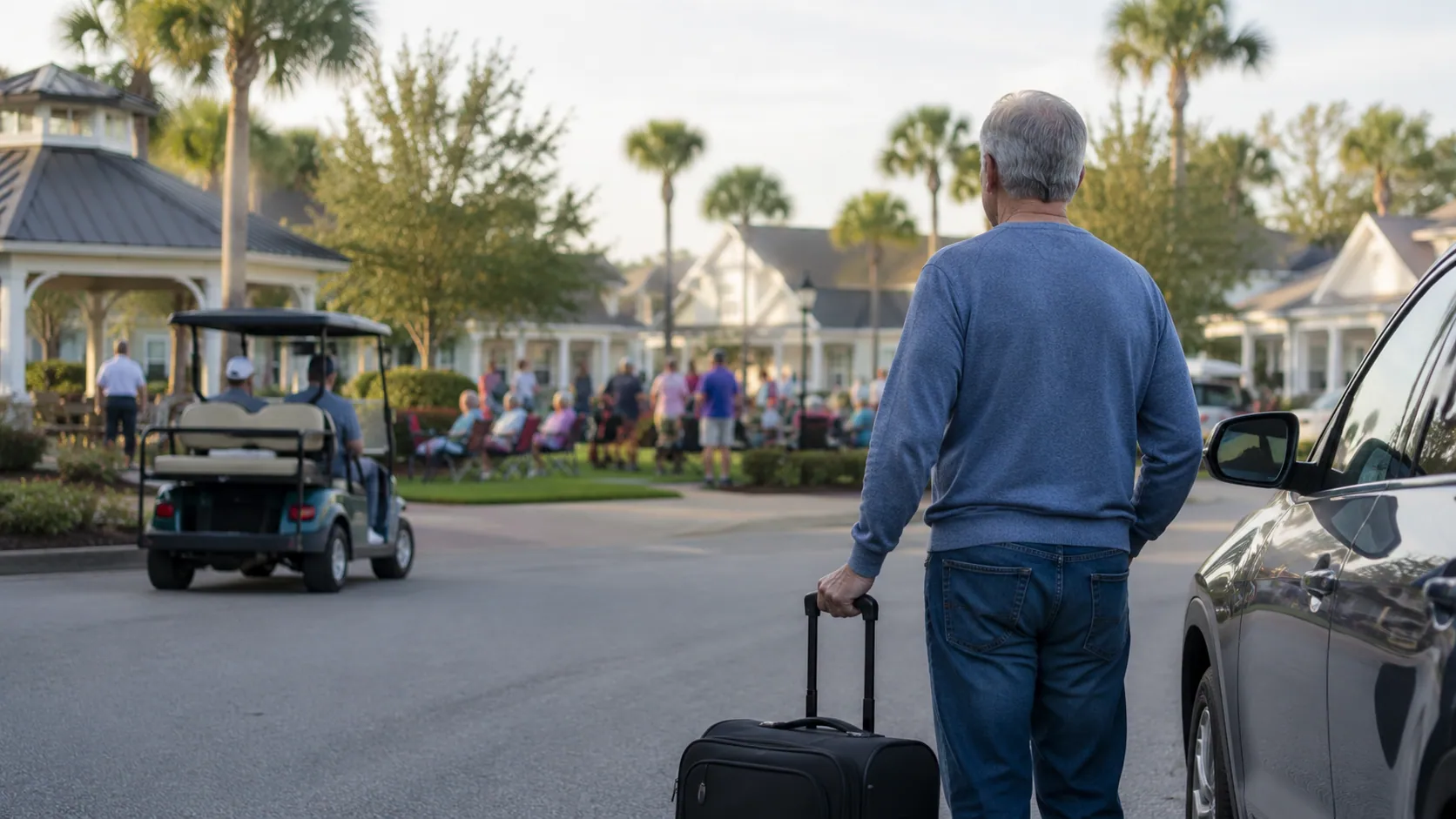
Why I left The Villages Florida is not a one-line answer, because The Villages really does offer a lot that attracts retirees in the first place. It is one of the biggest and best-known 55+ communities in the country, with a huge activity calendar, multiple town squares, golf-cart-friendly infrastructure, and an official pitch centered on active retirement living. The official site highlights a monthly amenity fee of $204, broad recreation access, and year-round outdoor living, while other recent coverage describes the community as home to more than 150,000 residents with extensive golf, pickleball, and entertainment options.
That is exactly why this topic matters so much in search. People are not just asking whether The Villages Florida is popular. They are asking whether it is right for them, whether the lifestyle still works after the honeymoon phase, and why some people decide to leave after moving there. Recent competitor content keeps circling the same themes: social isolation, cost of living, healthcare concerns, weather fatigue, crowding, golf-centered culture, and a feeling that the community can be too controlled or too uniform for some personalities.
This article takes a more balanced view. The Villages can be a fantastic fit for some retirees. But for others, the tradeoffs become too big to ignore. Here is what makes it appealing, what can wear on people over time, and what I would tell anyone thinking about moving there now.
What Makes The Villages So Appealing at First
It is easy to understand the initial attraction. The community is built around convenience, social clubs and activities, and a strong golf cart lifestyle. Recent coverage describes over 50 golf courses, over 200 pickleball courts, multiple town squares with nightly entertainment, and thousands of clubs. The official cost-of-living page also sells a version of retirement that feels active, outdoorsy, and highly organized. For someone who wants a place where there is always something to do, that is powerful.
At first, that structure can feel like relief. You do not have to invent a social life from scratch. You do not have to drive all over town to find recreation. You do not have to wonder whether there will be events, neighbors, or organized routines. The Villages packages retirement living into something that feels easy to step into, and that is a major reason it keeps attracting attention from people comparing Florida retirement options. Florida’s broader draw is also real: warm weather, no state income tax, and a steady influx of retirees continue to make the state attractive.
But that same polished environment can also create unrealistic expectations. What looks like a forever vacation feel from the outside may not feel that way after six months, a year, or several years of everyday life.
Why I Left The Villages Florida: The Biggest Reasons
The reasons usually are not dramatic in isolation. It is more like a slow accumulation of friction. You start with a place that looks almost ideal on paper, then discover that your day-to-day reality depends on deeper things: community fit, the kind of friendships you want, your tolerance for heat and crowds, your medical needs, your budget, and whether you actually enjoy the culture that dominates the area. Competitor pages that rank for this topic consistently return to those issues, and they do so for a reason.
It Felt Too Manufactured and Less Authentic Over Time
One of the most repeated emotional complaints is that The Villages can feel too curated. CoursePivot makes this point directly with its “It Felt Too Manufactured” framing, and that phrase resonates because it captures something many searchers are trying to understand: not whether the community is nice, but whether it feels natural.
There is a difference between well-planned and over-scripted. In a master-planned retirement community, everything is organized for ease, beauty, and consistency. That sounds great until a person begins to feel like daily life is happening inside a lifestyle brand. For some residents, the polished landscaping, recurring promotional tone, and strong identity of the place stop feeling charming and start feeling restrictive. The community can seem designed to support one version of retirement very well, but not necessarily every version.
That does not mean the appeal is fake. It means the experience can become repetitive if you value spontaneity, urban variety, age diversity, or a more mixed social environment. A lot of people looking up why the villages wasn’t for me are really searching for that exact distinction.
The Social Life Wasn’t as Easy or Deep as It Looked
This is probably one of the most important sections for search intent, because social isolation shows up again and again in the SERP. HotBot discusses the difficulty some newcomers face when trying to form meaningful relationships, even in a community that markets itself as socially rich.
That is a crucial point. A place can offer 3,500 clubs, events, games, and constant activity, yet still leave some people feeling lonely. Organized activity is not the same thing as emotional closeness. If you are outgoing, love joining groups, and enjoy the quick rhythm of community events, you may thrive. But if you are more introverted, moving alone, or hoping for deeper friendships rather than surface-level interaction, The Villages social life may not feel as effortless as the marketing suggests.
This is also where the difference between new friends and true belonging matters. Many retirees arrive after leaving behind long-term communities, adult children, old neighbors, churches, and familiar routines. Rebuilding that from scratch is hard anywhere. In The Villages, it may be easier to meet people but harder to know which connections will actually become lasting relationships. The forum-style competitor content around “reasons for leaving” repeatedly hints at this emotional layer, even when it does not state it in polished language.
For someone researching moving to The Villages alone or wondering about social life in The Villages for introverts, this is a major decision point. A busy calendar does not automatically solve loneliness.
The Costs Added Up More Than I Expected
A lot of competitor content mentions costs, but most of it stops at general warnings about fees. That is not enough. People making retirement decisions need a practical picture.
The official site currently lists a $204 monthly amenity fee, and the district utility information confirms that amenity charges are billed monthly in advance and adjusted on a schedule tied to deed restrictions and CPI-based reviews. That means the number is not frozen forever. Recent third-party coverage also notes updated amenity-fee levels around the high-$100s to low-$200s, depending on timing and the home.
That fee is only part of the story. When people look up hidden costs of living in The Villages or monthly cost to live in The Villages, they are usually thinking about the whole stack: home price, utilities, maintenance, golf-cart upkeep, insurance, property taxes, and possibly bond or district-related costs. Kiplinger’s recent reporting also highlights that home insurance can be a meaningful expense in Florida because of hurricane exposure, and broader Florida insurance reporting continues to show elevated premiums compared with national norms.
Here is a simple comparison block that reflects what many retirees are actually trying to evaluate:
| Cost factor | Why it matters |
| Amenity fee | Ongoing monthly access cost that can change over time |
| Property taxes | Affects long-term affordability even if home price feels manageable |
| Home insurance | Can be substantial in Florida because of storm risk |
| Utilities | Important in hot months when cooling demand rises |
| Golf cart / maintenance | Easy to underestimate in a golf-cart-heavy community |
| Healthcare spending | Becomes more important with age and specialist needs |
That is why cost of living in The Villages Florida cannot be treated as one fee or one headline number. It is the combination that matters.
Healthcare Became a Bigger Concern as I Thought Long Term
Healthcare is another repeated reason people leave. HotBot lists healthcare concerns, and ESI Money notes that worsening health or the need for higher-level care is among the most common reasons residents move on from The Villages.
This issue often starts quietly. At first, having nearby clinics and a visible healthcare ecosystem feels reassuring. In fact, recent reporting on life in The Villages points to convenient medical access as one of the community’s practical strengths. But convenience is not the same thing as a full answer to aging. As medical needs become more specialized, people start caring less about basic access and more about depth: wait times, specialist availability, continuity of care, and what happens if one partner needs assisted living, memory care, or skilled nursing.
This is where some retirees realize the community no longer fits their next chapter. The issue is not simply “bad healthcare.” It is that retirement planning changes over time. A place that works well for active early retirement may feel less ideal when health becomes more complex. Anyone comparing healthcare access for seniors in The Villages should think about both present convenience and future care needs.
The Heat, Humidity, and Storm Risk Wore Me Down
Plenty of people move to Florida for sunshine. Plenty of people also underestimate what hot humid summers feel like when they are no longer visiting for a week, but living there full time.
WeatherSpark’s climate data for The Villages shows that the hot season lasts about 4.6 months, from roughly mid-May to late September, with average daily highs above 86°F and the hottest period centered in July. Separate summer data shows daily highs around 90°F, rarely dropping below the low 80s during the season.
That matters because climate fatigue is not just about heat. It is about humidity, storm anxiety, bugs, indoor-outdoor routines, and how much of your lifestyle depends on being comfortable outside. Pepine Realty explicitly includes weather and bugs among reasons people leave, and multiple competitors mention the weather as a major downside.
For some retirees, the sunshine is energizing. For others, summer weather in The Villages Florida becomes draining enough that they start questioning whether the tradeoff is worth it. This is even more important for full-time residents than for snowbirds who can leave during the worst stretch.
The Community Felt Too Homogeneous for Me
Another recurring complaint is homogeneity of the community. Competitor pages frame this differently, but the core idea is the same: some people find comfort in a highly age-focused environment, while others find it limiting. CoursePivot uses the phrase “The Homogeneity Was Stifling,” and HotBot discusses sameness more broadly.
A 55+ community obviously attracts people at similar life stages. For many residents, that is a feature, not a bug. Shared retirement schedules, similar priorities, and common recreational interests can make daily life smoother. But age similarity does not automatically create a satisfying culture for everyone. Some residents miss intergenerational living, family variety, or a broader social mix. Others feel the political or cultural tone is too dominant.
This becomes especially relevant for people who enjoy being around working adults, younger neighbors, mixed-income neighborhoods, or a more urban social texture. If that is what energizes you, The Villages may feel comfortable but narrow.
Crowding, Growth, and Daily Convenience Became Frustrating
Recent reporting describes The Villages as a very large and still highly visible community, with more than 150,000 residents and a footprint of around 57 square miles. That scale helps explain why some people love it and why others eventually feel worn down by it.
Growth changes everyday life. Popular amenities get busier. Roads feel more crowded. Seasonal waves of residents affect the atmosphere. ESI Money specifically mentions high season crowds, while HotBot frames the issue as overcrowding and development.
This is not always a dealbreaker, but it does chip away at the relaxed image people often imagine before moving. When you are deciding whether The Villages Florida fits your retirement goals, convenience is not just about having a lot nearby. It is also about whether access still feels easy once everyone else is trying to do the same thing.
If You Don’t Love Golf, Parts of the Culture Can Feel Narrow
This point sounds trivial until you live it. Several competitors note that everything revolved around golf or that the place can feel too golf-centric.
To be fair, golf is far from the only activity there. Recent coverage points to pickleball, clubs, performances, and plenty of recreation beyond the course. But culture matters as much as inventory. Even if you do not play golf, you may still feel that golf sets the tone of the place: the rhythm, the conversation, the identity, and the social hierarchy.
So the better question is not “Are there non-golf activities?” There clearly are. The better question is can you live in The Villages if you do not golf and still feel fully at home. For some people, yes. For others, no.
The Rules and Restrictions Started to Feel Draining
A highly organized community almost always comes with more structure. That is one reason some people like it. It is also why some people leave.
Competitor coverage repeatedly points to HOA-style rules, deed restrictions, and fees as friction points. Pepine Realty’s result snippet highlights rules and fees directly, while CoursePivot makes “Too Many Rules” one of its main reasons for leaving. The district utility guidance also confirms that amenity arrangements and adjustments are tied to formal systems and deed-based timing rules.
For residents who value uniformity, predictability, and maintenance standards, that may be reassuring. But if you prefer flexibility around property use, decor, pets, or just a looser neighborhood feel, the structure can start to feel exhausting. That is when community lifestyle standards stop feeling like support and start feeling like pressure.
I Wanted a Different Chapter of Life
This is the most personal reason, and it may be the hardest to explain in a purely factual article. Sometimes the answer to why I left The Villages Florida is not that the place failed. It is that the place fit one stage of life and not the next.
Competitors express this in different ways: personal growth, outgrowing it emotionally, or wanting a new adventure.
That matters because searchers often assume leaving means regret or disaster. Not always. Sometimes a retiree simply realizes they want a smaller town, more family proximity, more age diversity, less structure, a different climate rhythm, or a lifestyle that feels less branded and more open-ended. A move away from The Villages can be a correction, not a failure.
Why Some People Still Love The Villages
A good article on this subject has to say this clearly: many people still love living in The Villages. Recent coverage highlights the community’s camaraderie, extensive recreation, golf-cart convenience, and strong sense of routine and belonging. Kiplinger’s reporting is especially clear that for retirees who want regular social activity and a built-in community, The Villages can be hard to beat.
So this is not a universal verdict. It is a fit question. If you want a highly social, highly organized, highly active retirement community, The Villages may be exactly what you want. If you value more privacy, more mixed-age energy, lower environmental stress, or a less structured lifestyle, you may feel differently.
Who Should Think Twice Before Moving There
In practical terms, who should not move to The Villages? The people most likely to struggle are those who dislike long hot summers, want deeper built-in family proximity, do not enjoy structured community culture, do not care for golf-centered identity, or need a highly customized healthcare plan that goes beyond convenient basics. People who prefer testing a place slowly may also do better by renting first rather than buying immediately.
A smarter decision framework is to ask:
- Will I enjoy this place in July, not just in January?
- Do I want organized community life, or just occasional access to it?
- Am I comfortable with ongoing fees and Florida insurance realities?
- Would I still like living here if I never played golf?
- What would happen if my healthcare needs changed quickly?
Those questions get closer to the truth than glossy marketing ever will.
Final Thoughts
In the end, why I left The Villages Florida comes down to a mismatch between the lifestyle the community is designed to deliver and the lifestyle some people actually want over time. The Villages offers real strengths: activities, convenience, sunshine, social opportunities, and a recognizable 55+ lifestyle. But it also comes with real tradeoffs: cost of living, weather stress, crowding, rules, and the possibility that the community may feel too uniform or too packaged for some personalities.
That is why the best takeaway is not “move there” or “never move there.” It is this: The Villages is a strong fit for some retirees and the wrong fit for others. The smartest move is to evaluate it honestly, in person, across real costs, real climate, and real long-term needs before treating it as your forever home.
Disclaimer: This article is for general informational and personal-opinion purposes only. Experiences living in The Villages, Florida can vary widely depending on lifestyle preferences, finances, health needs, social expectations, and personal circumstances. Community fees, insurance costs, healthcare access, amenities, and local conditions may change over time, so prospective residents should research carefully and visit in person before making relocation decisions.