

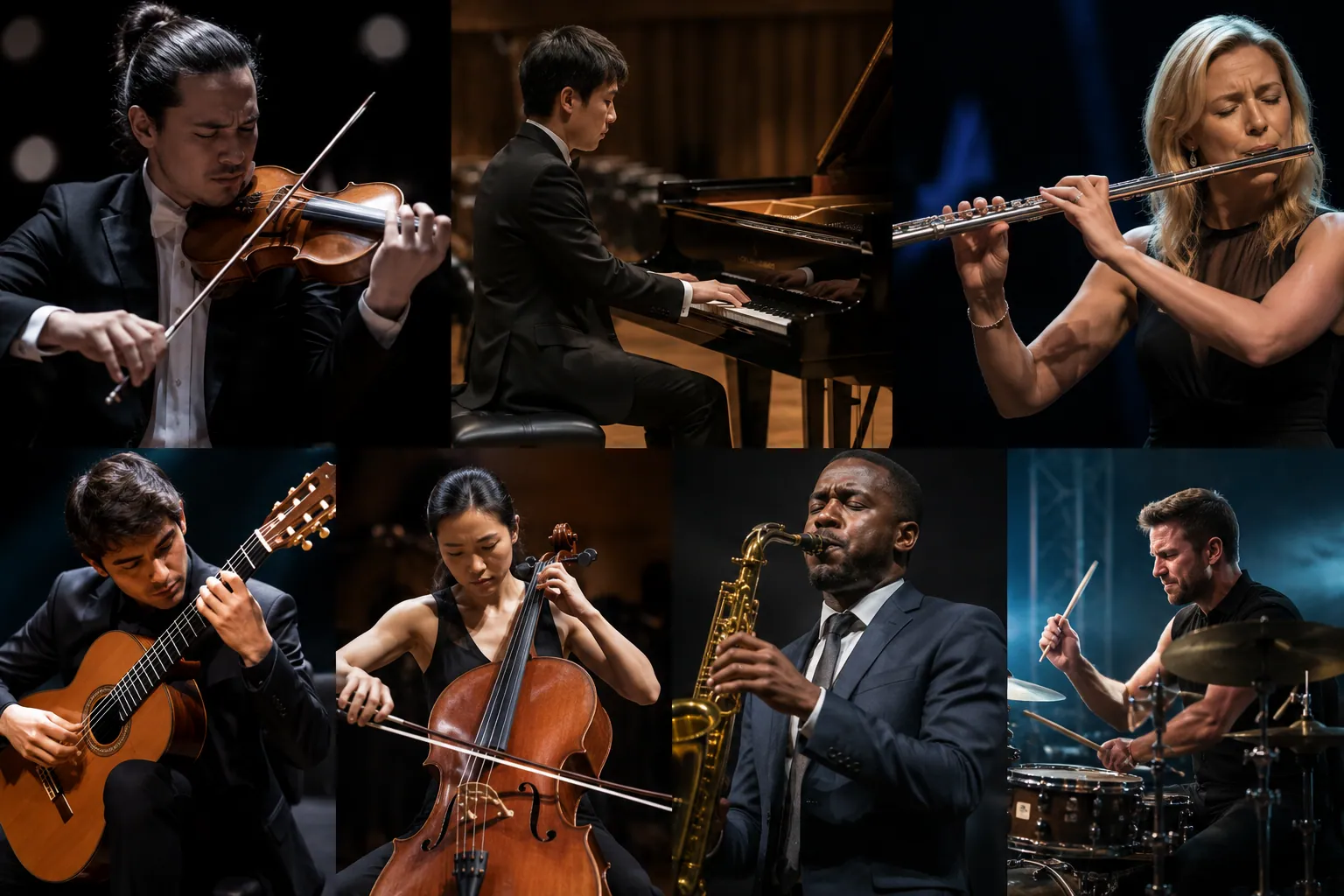
What are the hardest instruments to play is a question many beginners, music students, parents, and curious music lovers ask when comparing different musical instruments. The answer depends on what kind of difficulty you mean. Some instruments are hard because they demand perfect pitch control, some require advanced breath control, and others challenge your hand independence, rhythm, coordination, or physical stamina.
In general, the violin, French horn, oboe, pipe organ, harp, bassoon, accordion, bagpipes, drum kit, piano, cello, double bass, and guitar are often listed among the hardest instruments to learn and master. But difficulty is not always a bad thing. A challenging instrument can also be deeply rewarding if you enjoy the sound, stay patient, and build a steady practice routine.
Quick Answer: What Is the Hardest Instrument to Play?
The violin is often considered one of the hardest instruments to play because it has no frets, which means there are no fixed markers to show exactly where your fingers should go. A beginner must develop accurate finger placement, strong ear training, smooth bowing technique, and clean intonation before the instrument sounds controlled.
However, the violin is not the only answer. The French horn is one of the hardest brass instruments because tiny changes in embouchure, lip positioning, and air pressure can affect the pitch. The oboe is one of the hardest woodwind instruments because of its double reed, refined breath control, and delicate tone production. The pipe organ is extremely hard to master because players often use both hands, both feet, multiple keyboards, and pedals at the same time.
So, the real answer is this: the hardest instrument to play depends on whether you mean hardest to start, hardest to play in tune, hardest for coordination, or hardest to master professionally.
What Makes an Instrument Hard to Play?
Before ranking the hardest musical instruments, it is important to understand what actually makes an instrument difficult. An instrument is not hard for just one reason. Difficulty usually comes from a mix of technical complexity, physical demands, sound production, practice hours, and long-term musical mastery.
One major factor is tone production. Some instruments, like the piano, make a clear sound as soon as you press a key. Others, like the violin, French horn, oboe, and bagpipes, may sound rough or unstable at first. That beginner frustration often comes from the fact that the player must control the sound with the body, not just the fingers.
Another major factor is pitch accuracy. Instruments such as the violin, cello, and double bass require constant tuning awareness because the player must place the fingers very precisely. There are no frets like on a guitar, so even a tiny movement can make the note sound sharp or flat.
For wind and brass players, the challenge often comes from breath control, embouchure, airflow, and lip tension. For keyboard and percussion players, the hard part is often hand coordination, foot coordination, rhythm, and hand independence.
Real-world factors matter too. Some instruments are hard because they are expensive, large, noisy, or difficult to practice at home. A harp, pipe organ, or drum kit may be challenging not only because of technique but also because of instrument access, practice space, maintenance, and teacher availability.
Hardest Instruments to Play: Ranked List
1. Violin
The violin is often placed at the top of any list of the hardest instruments to learn. It looks small and elegant, but it demands extreme precision. The violin has four strings, a fretless neck, and no visual markers for exact notes. That means players must rely on muscle memory and ear training to develop accurate intonation.
What makes the violin especially difficult is the combination of left-hand finger placement and right-hand bow control. The player must manage bow pressure, bow speed, posture, rhythm, and pitch all at once. A small mistake can create a scratchy tone or an out-of-tune note.
The violin is hard from the very first lesson, but it is also one of the most expressive and rewarding stringed instruments for players who enjoy classical music, folk music, orchestral performance, and solo repertoire.
2. French Horn
The French horn is widely known as one of the hardest brass instruments to play. Its difficulty comes from the way players control sound with their lips, breath, and mouth shape. This is called embouchure, and on the French horn, it must be extremely precise.
Unlike some brass instruments where notes feel more secure, the French horn has close partials, which means it is easy to miss the intended pitch. A small change in lip positioning, air pressure, or breath support can send the note in the wrong direction. This makes pitch control one of the biggest challenges.
The French horn also requires strong lung capacity, patience, and a good ear. It can sound warm, heroic, and beautiful in an orchestra, but it takes serious practice to make it sound effortless.
3. Oboe
The oboe is often described as one of the hardest woodwind instruments to learn. Its biggest challenge is the double reed, which is small, sensitive, and difficult to control. The reed affects the tone, pitch, airflow, and response of the instrument.
Players need refined breath control, steady air pressure, and careful mouth technique to create a clear sound. The oboe does not forgive poor control easily. Even experienced players spend time adjusting reeds because the instrument’s tone can change with reed quality, humidity, and small physical details.
The oboe is not always the loudest instrument in an orchestra, but its sound is very exposed. When it plays a melody, every note needs strong intonation, smooth phrasing, and controlled tone production. That is why many musicians consider it one of the most difficult instruments to play.
4. Pipe Organ
The pipe organ is difficult in a completely different way. It may be easier to create a sound than on the violin or oboe, but mastering it requires extraordinary coordination. A pipe organ can include multiple manual keyboards, pedals, and many organ stops. Some large organs may have 5 manual keyboards, dozens of stops, and another keyboard for the feet.
Organ players must read multiple lines of music while using both hands and both feet. This creates a level of hand independence and foot coordination that can feel overwhelming at first. The player may need to control melody, harmony, bass lines, registration, timing, and dynamics all at once.
The organ is also hard because of access. Not everyone has a pipe organ at home, and practicing may require access to churches, concert halls, or special music spaces.
5. Harp
The harp is one of the most beautiful but demanding instruments to play. A concert harp can have up to 47 strings, plus pedals that change pitch. The player must coordinate both hands while also managing the pedals with the feet.
Unlike piano keys, harp strings are spread vertically, and the player must learn exact hand positions, finger strength, and smooth plucking technique. The instrument also requires careful tuning and regular maintenance. Because of its size and cost, the harp can be difficult for beginners to access.
The harp is physically graceful, but it is not simple. It demands hand coordination, finger independence, strong listening skills, and patience. It can be hard to transport, hard to maintain, and hard to practice without enough space.
6. Bassoon
The bassoon is another difficult double-reed instrument. Like the oboe, it requires careful reed control, breath support, and precise fingerings. But the bassoon is larger and has a more complex key system, which can make it physically awkward for beginners.
The instrument’s tone is rich and deep, but producing a clean sound requires control of airflow, mouth shape, and reed response. Bassoon players also need strong reading skills because bassoon parts can move between bass, tenor, and sometimes even higher registers.
The bassoon is often less common than flute, clarinet, or saxophone, which can make teacher availability and instrument rental more difficult in some areas. For students who enjoy a unique orchestral voice, though, it can be a wonderful choice.
7. Accordion
The accordion is harder than many people expect because it combines several skills at once. The player uses one hand for melody or keyboard work, the other hand for bass buttons or chords, and the arms to control the bellows.
The bellows are central to the sound. If the player does not control them smoothly, the tone can feel uneven. At the same time, the left hand often works without being clearly visible, which makes muscle memory very important.
The accordion requires strong coordination, rhythm, finger independence, and physical control. It is not just a keyboard instrument. It is a breathing, moving instrument that demands timing between both hands and the bellows.
8. Bagpipes
The bagpipes are difficult because they require steady air pressure and coordination between the bag, chanter, and drones. The player must keep the sound continuous while controlling the melody and maintaining stable pressure.
Unlike many instruments, bagpipes do not pause in the same way. Once the drones are sounding, the player must manage breath and arm pressure so the tone does not collapse or become unstable. This takes stamina, timing, and control.
Bagpipes are also loud, which can make home practice difficult. They are strongly connected with Scottish tradition and Celtic tradition, and their powerful sound is part of what makes them special. But that same sound can be challenging for beginners who need quiet, flexible practice conditions.
9. Drum Kit
The drum kit is one of the hardest instruments for full-body coordination. A drummer often uses both hands and both feet at the same time, controlling sticks, cymbals, pedals, and drums while keeping a steady beat.
At a basic level, drums can feel approachable because beginners can create a sound quickly. But mastering drums requires strong rhythm, timing, limb independence, endurance, and listening skills. The drummer must support the entire band or ensemble, which means small timing errors can affect everyone else.
The drum kit also has practical challenges. It needs space, can be noisy, and may require electronic alternatives for quiet practice. For rhythm-focused learners, however, it can be one of the most exciting and rewarding instruments.
10. Piano
The piano is easy to start but very hard to master. A beginner can press a key and get a clean note immediately, which makes piano feel friendly at first. But advanced piano playing requires deep music theory, hand independence, reading skills, pedal control, and emotional expression.
Pianists often read two rows of sheet music at the same time, one for the right hand and one for the left hand. They must manage melody, harmony, rhythm, dynamics, and pedal timing together. At higher levels, the piano becomes one of the most complex instruments because it can play many voices at once.
This is why many people say the piano is not the hardest instrument to begin, but it may be one of the hardest instruments to master.
11. Cello and Double Bass
The cello and double bass are challenging large stringed instruments. Like the violin, they require accurate finger placement on a fretless fingerboard. But because they are larger, they also demand more physical strength, posture control, and hand movement.
The double bass has thick strings and wide spacing, which can be difficult for smaller hands. The cello requires smooth bowing, strong intonation, and a relaxed but controlled playing position. Both instruments depend heavily on pitch accuracy, bowing technique, and ear training.
These instruments can sound warm, deep, and emotional, but they take time to control. They are especially challenging when playing fast passages, high notes, or expressive solo music.
12. Guitar
The guitar may not seem like one of the hardest instruments at first because many people learn basic chords fairly quickly. But advanced guitar playing has a very high skill ceiling. Chord shapes, finger strength, rhythm, picking technique, and fretboard knowledge can take years to develop.
Beginners often struggle with finger pain, buzzing strings, and switching chords smoothly. Later, guitar becomes difficult through advanced styles like classical guitar, jazz, metal, flamenco, and complex fingerstyle playing.
So, is guitar one of the hardest instruments to start? Usually not. But is it hard to master? Absolutely. Like piano, it is a great example of an instrument that starts simple but becomes extremely deep.
Hard to Start vs Hard to Master
One of the biggest mistakes beginners make is thinking that all difficulty is the same. Some instruments are hard to start, while others are hard to master.
For example, the violin, oboe, French horn, bassoon, and bagpipes can be frustrating in the beginning because it is hard to make a pleasant sound right away. They demand pitch control, breath control, or tone production from the first day.
On the other hand, piano, guitar, and drums can feel easier at the beginning because you can make a sound quickly. But advanced playing becomes very difficult because of hand independence, rhythm, harmony, speed, interpretation, and professional-level technique.
| Hard to Start | Hard to Master |
| Violin | Piano |
| Oboe | Guitar |
| French horn | Drum kit |
| Bassoon | Pipe organ |
| Bagpipes | Harp |
This is why the hardest instrument for beginners may not be the same as the hardest instrument to master. A beginner may struggle most with the violin, while a professional musician may argue that piano, organ, or drums have an endless level of complexity.
Hardest Instruments Ranked by Skill Type
A better way to understand instrument difficulty is to rank instruments by the skill they test most.
For pitch accuracy, the hardest instruments are often the violin, cello, double bass, and French horn. These instruments require constant listening and exact adjustment. The violin is especially difficult because it has no frets, while the French horn is difficult because notes can be easy to miss.
For breath control, the hardest instruments include the French horn, oboe, bassoon, and bagpipes. These instruments require steady airflow, careful mouth position, and strong stamina.
For coordination, the pipe organ, accordion, drum kit, and piano are especially difficult. The player must often control both hands and feet while reading music or keeping rhythm.
For physical stamina, the drum kit, bagpipes, double bass, and harp stand out. They can require endurance, strength, posture control, and repeated movement.
For practice environment, the hardest instruments may be drums, bagpipes, harp, and pipe organ because they can be loud, large, expensive, or difficult to access.
Difficulty Comparison Table: Hardest Instruments at a Glance
| Instrument | Main Difficulty | Beginner Difficulty | Mastery Difficulty | Practice Challenge |
| Violin | Intonation and bowing | Very high | Very high | Quiet enough, but technically demanding |
| French horn | Embouchure and pitch | High | Very high | Needs strong teacher support |
| Oboe | Double reed and breath | Very high | High | Reed maintenance |
| Pipe organ | Hands, feet, and manuals | Medium | Very high | Access to instrument |
| Harp | Strings and pedals | High | High | Size, cost, and tuning |
| Bassoon | Reed and fingerings | High | High | Instrument access |
| Accordion | Bellows and hands | Medium | High | Coordination-heavy |
| Bagpipes | Air pressure and drones | High | High | Very loud practice |
| Drum kit | Limb independence | Medium | Very high | Noise and space |
| Piano | Hand independence | Low to medium | Very high | Long-term mastery |
| Cello / Double bass | Pitch and posture | High | High | Size and strength |
| Guitar | Chords and technique | Medium | Very high | Finger pain and skill ceiling |
This table shows why a single ranking can never tell the full story. The hardest instruments ranked by difficulty change depending on whether you care most about pitch, breath, coordination, stamina, or practical learning barriers.
Are the Hardest Instruments Worth Learning?
Yes, the hardest instruments to learn can absolutely be worth it. A difficult instrument can teach patience, discipline, listening, focus, and creative expression. The key is choosing an instrument because you love its sound, not just because it looks impressive.
Beginners should not automatically avoid hard instruments. If you love the violin, oboe, French horn, harp, or drums, that interest can keep you motivated through frustrating stages. The most important thing is to set realistic expectations. You may not sound polished on the first try, and that is normal.
As one music teacher might say, “The best instrument is not always the easiest one. It is the one you will still want to pick up tomorrow.”
A hard instrument becomes more manageable with a patient teacher, a clear practice routine, slow practice, and small goals. Even 20 focused minutes a day can help build muscle memory, confidence, and long-term progress.
How to Choose a Difficult Instrument Without Getting Frustrated
If you are choosing between difficult instruments, think beyond the ranking. Start with your musical goals. Do you want to play in an orchestra, a band, a church, a folk group, or alone at home? A violin or French horn may suit orchestral music, while guitar or piano may be more flexible for songwriting and solo playing.
Next, consider your practice space. If you live in an apartment, drums and bagpipes may be difficult because of noise level. If you have limited space or budget, a harp, double bass, or pipe organ may be less practical.
Teacher availability also matters. Instruments like violin, piano, and guitar usually have many teachers available. Instruments like bassoon, oboe, harp, or bagpipes may require more searching.
Finally, match the instrument to your body and habits. Hand size, lung capacity, posture, and patience can all affect the learning experience. But none of these should stop you if you are truly interested. They simply help you choose wisely and avoid unnecessary frustration.
Difficult Instruments from Around the World
Most lists of the hardest instruments to play focus on Western orchestral instruments, but many world music instruments are also extremely challenging. The sitar and tabla in Indian classical music require years of training, complex rhythm, and deep tradition. The sarangi is known for expressive pitch control and difficult bowing.
The oud in Middle Eastern music, the erhu in East Asian traditional music, the shakuhachi flute, the duduk, and the uilleann pipes all require specialized technique and cultural understanding. These instruments show that difficulty is not limited to classical orchestras.
Regional music traditions often have their own standards of mastery. An instrument may be difficult not only because of its physical technique, but because of its style, ornamentation, improvisation, and history.
Final Verdict: What Is Really the Hardest Instrument to Play?
So, what are the hardest instruments to play overall? If we look at beginner difficulty, the violin, oboe, French horn, and bagpipes are among the toughest because they are hard to make sound good at first. If we look at coordination, the pipe organ, accordion, drum kit, and piano are extremely demanding. If we look at long-term mastery, the piano, violin, organ, and guitar have very high skill ceilings.
The best overall answer is that the violin is one of the hardest instruments because it combines intonation, bowing technique, finger placement, ear training, and expressive control. But the French horn and oboe are just as challenging in different ways.
The hardest instrument for you personally will depend on your body, ear, patience, practice space, teacher access, and musical goals.
FAQs About the Hardest Instruments to Play
What is the hardest instrument to play?
The violin is often considered the hardest instrument to play because it requires exact finger placement, smooth bowing technique, and strong intonation without frets. However, the French horn, oboe, pipe organ, and harp are also among the most difficult instruments.
Is violin harder than piano?
The violin is usually harder at the beginning because producing a clean, in-tune sound takes time. Piano is easier to start because the keys create clear notes immediately. However, the piano can be harder to master because of hand independence, multiple voices, advanced harmony, and complex sheet music.
Why is the French horn so hard to play?
The French horn is hard because it requires precise embouchure, controlled breath support, accurate lip positioning, and excellent pitch control. Small changes in air or mouth shape can cause the wrong note to come out.
Why is the oboe considered difficult?
The oboe is difficult because it uses a double reed, which is sensitive and hard to control. Players need steady air pressure, refined breath control, and careful mouth technique to create a stable tone.
Which instrument is easiest to start but hardest to master?
The piano is one of the easiest instruments to start but one of the hardest to master. Beginners can make a clean sound quickly, but advanced pianists must control rhythm, harmony, dynamics, hand independence, pedal timing, and musical expression.
Should beginners avoid difficult instruments?
No. Beginners do not need to avoid difficult instruments if they love the sound and are willing to practice. A hard instrument becomes easier with good lessons, patience, realistic goals, and consistent practice. The best instrument is the one you feel motivated to keep learning.
Disclaimer: This article is for general informational and educational purposes only and does not constitute professional music, educational, or career advice. Musical instrument difficulty is subjective and may vary based on individual aptitude, physical ability, learning style, practice habits, and instruction quality. Always choose an instrument based on your interests, goals, and personal enjoyment.