

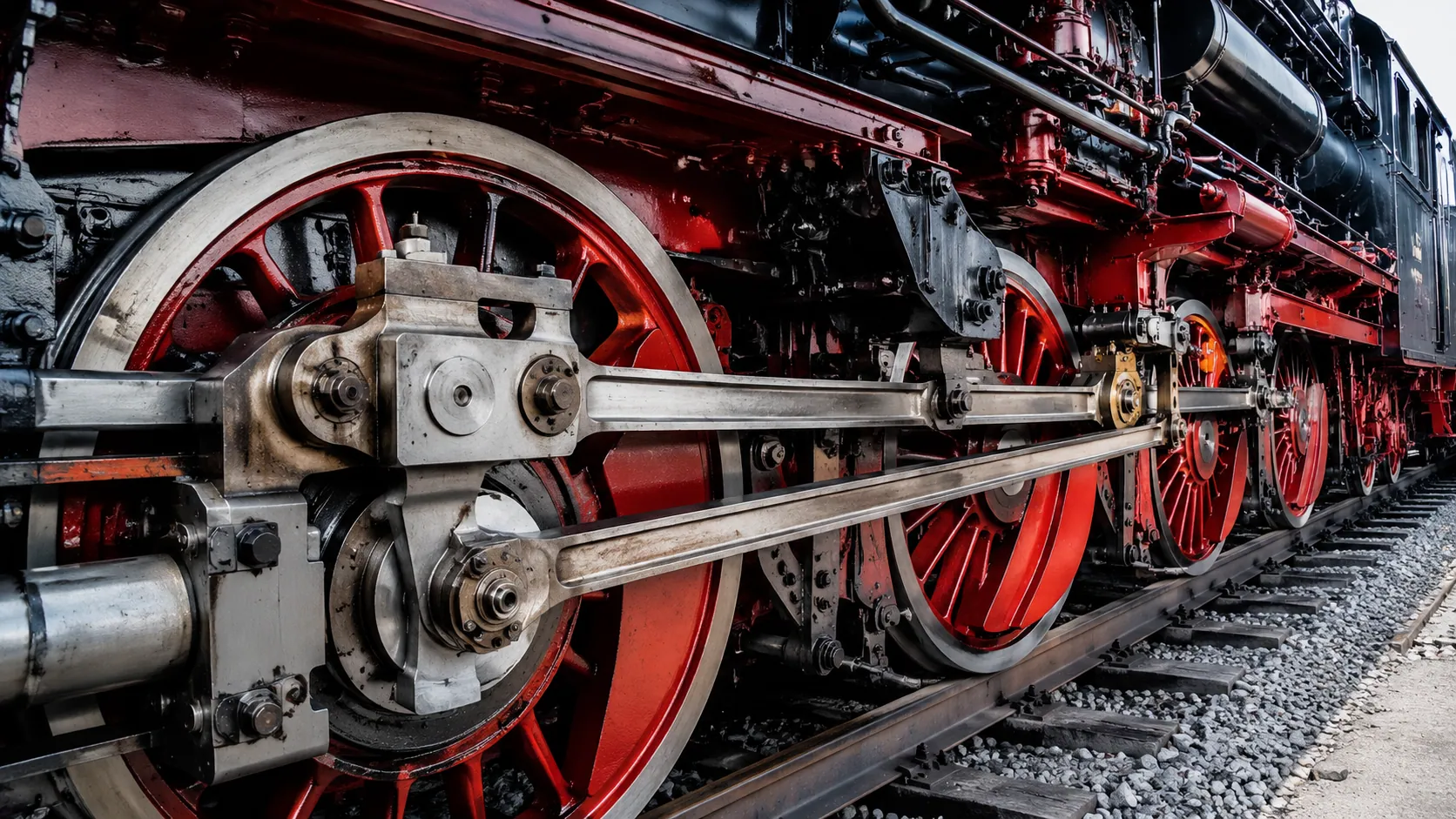
In a locomotive the ratio of the connecting rod length to the crank radius is kept very large to reduce the effect of secondary unbalanced forces. This is the direct and most important answer students usually need when they see this question in mechanical engineering exams.
In simple words, a locomotive has parts that move back and forth, such as the reciprocating mass connected through the connecting rod and crank radius. Because the connecting rod does not remain perfectly straight during motion, it creates additional acceleration effects. These effects produce what is known as secondary unbalanced force. When the connecting rod length to crank radius ratio is made large, the secondary force becomes smaller, making the motion smoother.
This topic belongs to Theory of Machines, especially the chapter on locomotive balancing, reciprocating masses, crank and connecting rod motion, and machine dynamics. Many students search for the phrase “in a locomotive the ratio of the connecting rod length” because it commonly appears in mechanical engineering MCQs, ESE/IES-style objective questions, railway engineering basics, and machine dynamics exams.
So, the key idea is simple: a larger connecting rod length compared with the crank radius helps reduce the harmful effect of secondary unbalanced force in a locomotive.
What Does “Ratio of Connecting Rod Length to Crank Radius” Mean?
The ratio of connecting rod length to crank radius shows how long the connecting rod is compared with the radius of the crank. In the crank and connecting rod mechanism, this ratio is usually written as:
n=lrn = \frac{l}{r}n=rl
Here:
- l = length of the connecting rod
- r = crank radius
- n = ratio of connecting rod length to crank radius
In simple words, the connecting rod length is the distance between the two ends of the connecting rod, while the crank radius is the distance from the center of the crankshaft to the crank pin. The value of n tells us how many times longer the connecting rod is than the crank radius.
A larger l/r ratio means the connecting rod is much longer than the crank radius. Because of this, the rod moves with less angularity during operation. When the rod movement becomes less angular, the piston motion or reciprocating motion becomes smoother, and the effect of secondary unbalanced force is reduced.
It is also helpful to understand the difference between a few related terms. The connecting rod length is the actual length of the rod that connects the crank to the reciprocating part. The crank radius is half of the stroke, because the crank moves the piston or crosshead from one end position to the other. The stroke is the total distance moved by the reciprocating part in one complete travel from one extreme position to the other. Reciprocating motion means the back-and-forth movement of parts such as the piston, crosshead, or other reciprocating mass in a locomotive mechanism.
For example, if the connecting rod length is 300 mm and the crank radius is 75 mm, then:
n=30075=4n = \frac{300}{75} = 4n=75300=4
So, the rod ratio is 4. This means the connecting rod is four times longer than the crank radius. In a locomotive, keeping this ratio large helps improve the behavior of the locomotive mechanism by reducing the secondary effects caused by connecting rod angularity.
Why Is This Ratio Kept Very Large in a Locomotive?
In a locomotive, the ratio of the connecting rod length to the crank radius is kept very large mainly to minimize secondary unbalanced forces. This is the most important point to remember for exams and for understanding balancing of reciprocating masses.
The reason comes from the formula of secondary unbalanced force. The secondary force includes the term 1/n, where n is the ratio of connecting rod length to crank radius:
Fs=mω2r×cos2θnF_s = m\omega^2r \times \frac{\cos 2\theta}{n}Fs=mω2r×ncos2θ
Here, m is the reciprocating mass, ω is the angular velocity, r is the locomotive crank radius, θ is the crank angle, and n is the large connecting rod ratio. Since n is in the denominator, increasing the value of n reduces the secondary unbalanced force. In simple words, the longer the connecting rod is compared with the crank radius, the smaller the secondary effect becomes.
This is why locomotives are designed with a large connecting rod ratio. It helps reduce vibration and improves the smoothness of the mechanism. However, this does not mean the locomotive becomes perfectly balanced.
For exam purposes, remember this clearly: the ratio is kept very large to minimize secondary forces. It is not mainly used to minimize primary forces, because primary force does not depend on the connecting rod ratio in the same direct way. It is also not used to achieve perfect balancing, because complete balancing of reciprocating parts in a locomotive is practically difficult. And it is definitely not related to starting the locomotive quickly.
Several mechanical engineering exam-prep explanations give the same answer: in a locomotive, a large connecting rod length to crank radius ratio is used to minimize secondary unbalanced forces. This makes it a key concept in locomotive balancing, Theory of Machines, and machine dynamics.
Primary and Secondary Unbalanced Forces in a Locomotive
In a locomotive, the moving parts do not only rotate; some parts also move back and forth. These back-and-forth moving parts are called reciprocating masses. Because they accelerate and slow down during every crank rotation, they produce reciprocating engine forces. These forces are mainly divided into primary unbalanced force and secondary unbalanced force.
The primary unbalanced force is the main force caused by the back-and-forth acceleration of the reciprocating parts. It acts along the line of stroke and depends on the crank angle. In simple terms, when the piston or crosshead moves forward and backward, its changing speed creates this primary force.
The basic formula for primary unbalanced force is:
Fp=mω2rcosθF_p = m\omega^2r\cos\thetaFp=mω2rcosθ
Here, m is the reciprocating mass, ω is the angular velocity of the crank, r is the crank radius, and θ is the crank angle.
The secondary unbalanced force is an additional force caused mainly by the angularity of the connecting rod. Since the connecting rod moves at an angle instead of staying perfectly straight, the motion of the reciprocating part is not perfectly simple harmonic. This creates an extra force known as the secondary unbalanced force.
The basic machine dynamics formula for secondary unbalanced force is:
Fs=mω2rcos2θnF_s = m\omega^2r \frac{\cos 2\theta}{n}Fs=mω2rncos2θ
In this formula, n represents the ratio of connecting rod length to crank radius:
n=lrn = \frac{l}{r}n=rl
This is why the secondary unbalanced force is more affected by the connecting rod ratio. The value of n appears in the denominator of the formula. So, when the connecting rod-to-crank radius ratio becomes larger, the secondary force becomes smaller.
An expert way to remember this is: primary forces are mainly controlled by balancing methods, such as balancing a portion of the reciprocating mass with rotating counterweights. However, secondary forces are reduced by using a larger connecting rod-to-crank radius ratio, because a longer connecting rod reduces the angularity of connecting rod motion and lowers the secondary effect in the locomotive mechanism.
How the Connecting Rod Ratio Affects Locomotive Motion
The connecting rod ratio has a direct effect on locomotive motion because it controls how much the connecting rod tilts during operation. When the connecting rod is longer compared with the crank radius, the obliquity angle of the rod becomes smaller. This means the rod does not move at a sharp angle while transferring motion from the crank to the reciprocating part.
A smaller rod angularity helps the piston or crosshead move more smoothly along its line of stroke. In a crank mechanism, the piston or crosshead is connected to a rotating crank through the connecting rod. Because of this arrangement, the motion is not perfectly uniform. Engineers use piston motion equations to study this reciprocating motion and understand how the crank, connecting rod, and piston behave at different crank angles.
When the value of n is large, the secondary component of motion becomes less important. In simple words, a larger obliquity ratio reduces the extra acceleration effect caused by connecting rod angularity. This helps in vibration reduction and improves the working behavior of the locomotive mechanism.
In practical terms, a larger connecting rod ratio can support:
- Lower secondary vibration
- Reduced hammering tendency
- Smoother operation
- Less stress on guides, pins, crank, and bearings
- More stable piston acceleration
- Better chance of a smooth running locomotive
For students, the easiest way to remember this concept is: when n becomes larger, the effect of the secondary component becomes smaller. That is why the connecting rod length is kept large compared with the crank radius in a locomotive.
Why a Large Ratio Does Not Mean Perfect Balancing
A common mistake in mechanical engineering MCQs is assuming that a large connecting rod ratio gives perfect balancing in a locomotive. This is not correct. A large ratio of connecting rod length to crank radius helps reduce secondary unbalanced forces, but it does not remove all unbalanced forces from the locomotive.
A locomotive still has several sources of vibration and dynamic force, such as reciprocating masses, rotating masses, wheel-rail dynamic effects, swaying couple, and hammer blow. These forces act in different ways during motion, so increasing the connecting rod ratio alone cannot balance the whole system perfectly.
The main reason is that reciprocating mass balancing is more complicated than simply adding counterweights or changing rod length. When engineers try to balance reciprocating masses, they may reduce one force but introduce another force in a different direction. For example, balancing part of the reciprocating mass can reduce horizontal unbalanced force, but it may also increase vertical effects on the rail. This is why locomotive balancing is usually a case of partial balancing, not perfect balancing.
In practical locomotive design, engineers try to reduce the most harmful locomotive unbalanced forces while keeping the machine safe, smooth, and reliable. The goal is better operation, not mathematically perfect balance.
For exam purposes, remember this tip: if the options include “perfect balancing”, it is not the correct answer. The correct reason for keeping the connecting rod ratio very large is to minimize secondary unbalanced forces, not to achieve perfect balancing.
Formula-Based Explanation for Students
The easiest way to understand why the connecting rod ratio matters is to look at the secondary force formula. In locomotive balancing, the secondary unbalanced force is commonly written as:
Fs=mω2rcos2θnF_s = m\omega^2r \frac{\cos 2\theta}{n}Fs=mω2rncos2θ
Here:
- FsF_sFs = secondary unbalanced force
- m = reciprocating mass
- ω\omegaω = angular velocity
- r = crank radius
- θ\thetaθ = crank angle
- n = connecting rod length / crank radius
The connecting rod ratio formula is:
n=lrn = \frac{l}{r}n=rl
This means n equals l by r, where l is the connecting rod length and r is the crank radius. The important point is that n appears in the denominator of the secondary force formula. Because of this, the secondary unbalanced force becomes smaller when n becomes larger.
In simple terms:
- If n increases, the secondary force decreases.
- If n decreases, the secondary force increases.
For example, if n = 4, the secondary force term is divided by 4:
cos2θ4\frac{\cos 2\theta}{4}4cos2θ
But if n = 5, the same term is divided by 5:
cos2θ5\frac{\cos 2\theta}{5}5cos2θ
So, when the value of n increases from 4 to 5, the secondary effect becomes smaller. This is why, in a machine dynamics numerical or MCQ, a larger connecting rod length compared with the crank radius is linked with reducing the secondary unbalanced force.
This formula-based explanation also shows why the answer is not about perfect balancing or starting the locomotive quickly. The formula clearly proves that the connecting rod length to crank radius ratio mainly affects the secondary force, not every force in the locomotive system.
Common Exam Question and Correct Answer
This topic is often asked as a locomotive ratio MCQ in Theory of Machines objective questions. The common question usually appears like this:
In a locomotive, the ratio of the connecting rod length to the crank radius is kept very large in order to:
- Minimize primary forces
B. Minimize secondary forces
C. Have perfect balancing
D. Start the locomotive quickly
Correct answer: B. Minimize secondary forces
The reason is simple. The primary force does not contain the term 1/n in the same direct way. Primary force mainly depends on the reciprocating mass, angular velocity, crank radius, and crank angle.
The secondary force, however, contains n in the denominator:
Fs=mω2rcos2θnF_s = m\omega^2r \frac{\cos 2\theta}{n}Fs=mω2rncos2θ
Here, n is the ratio of connecting rod length to crank radius. When n increases, the value of the secondary force decreases. That is why a large connecting rod ratio is used to minimize secondary forces in a locomotive.
Many exam-prep pages give the same answer for this connecting rod length to crank radius MCQ: the ratio is kept very large to reduce or minimize secondary unbalanced forces, not to minimize primary forces, achieve perfect balancing, or start the locomotive quickly.
Practical Engineering Importance of the Connecting Rod Ratio
The connecting rod ratio is not only important for exams. It also has real value in locomotive design, mechanical design, and railway engineering because it affects how smoothly the crank and reciprocating parts work together.
A good connecting rod ratio supports better dynamic balance. When the connecting rod is long enough compared with the crank radius, the angular movement of the rod becomes smaller. This helps reduce the secondary effects in the crank mechanism design and improves the overall motion of the locomotive.
In practical terms, a suitable ratio can help with:
- Reduced vibration
- Lower guide pressure
- Better reliability
- Less wear in moving parts
- Improved vibration control
- Smoother force transfer through the crank and connecting rod
This matters because locomotive parts work under heavy load. The crank, connecting rod, pins, bearings, guides, and crosshead must handle repeated forces during every rotation. If the rod ratio is poor, the motion can become rougher, and the parts may experience more stress and wear.
However, engineers do not simply make the connecting rod infinitely long. In real connecting rod design, every choice has limits. The final design depends on factors such as available space, wheel arrangement, stroke length, cylinder position, material strength, and maintenance needs.
From an expert engineering point of view, the goal is to find a practical balance. A longer rod can reduce secondary effects, but it also adds weight, takes more space, and may create construction challenges. That is why a locomotive uses a large connecting rod-to-crank radius ratio, but still within realistic design limits.
Quick Revision Notes on Locomotive Connecting Rod Ratio
Here are the key locomotive connecting rod ratio notes for quick revision:
The ratio of connecting rod length to crank radius is written as:
n=lrn = \frac{l}{r}n=rl
Here, l is the connecting rod length, r is the crank radius, and n is the connecting rod ratio.
In locomotives, this ratio is kept large because the main purpose is to reduce secondary unbalanced forces. The secondary force is inversely proportional to n, which means when n increases, the secondary force decreases.
A large connecting rod ratio improves smoothness, but it does not mean perfect balancing. Locomotives still have rotating masses, reciprocating masses, hammer blow, and other dynamic effects. This concept is an important part of balancing of reciprocating masses in Theory of Machines.
Remember this:
Large rod ratio = smaller secondary force effect.
Conclusion: In a Locomotive the Ratio of the Connecting Rod Length
In a locomotive the ratio of the connecting rod length to the crank radius is kept very large to minimize the effect of secondary unbalanced forces. This is the main reason this concept is important in locomotive balancing and machine dynamics.
The ratio is written as:
n=lrn = \frac{l}{r}n=rl
Here, l is the connecting rod length, r is the crank radius, and n is the ratio of connecting rod length to crank radius. The secondary unbalanced force contains the term 1/n, which means the secondary force becomes smaller when n increases.
So, a larger connecting rod ratio helps reduce the secondary effect and improves the smoothness of locomotive motion. However, it does not provide perfect balancing because a locomotive still has reciprocating masses, rotating masses, hammer blow, swaying couple, and other dynamic forces.
Once you understand the secondary force formula, this question becomes easy to remember instead of just memorizing the MCQ answer.
Disclaimer
This article is for general informational and educational purposes only. Mechanical concepts, formulas, and interpretations may vary depending on course material, exam board, textbook, or engineering application. Readers should consult their instructor, official syllabus, or trusted technical references for specific academic or professional guidance.