

Introduction
How does the mouth of goldfish work is a question many fish owners ask the moment they notice their pet constantly opening and closing its mouth, sucking up gravel, or spitting food back out. At first, the behavior can look strange, even worrying. But in most cases, the goldfish mouth is doing exactly what it was designed to do: feeding, sorting, and helping the fish move water across its gills.
A goldfish mouth is not built like a human mouth. Goldfish do not nibble the way mammals do, and they do not chew with visible front teeth. Instead, they use a clever combination of mouth movement, suction feeding, oral cavity control, and pharyngeal teeth deeper in the throat to gather and process food. That is why you may see a goldfish suck in pellets, mouth the substrate, or spit out bits of sand and gravel during normal goldfish feeding behavior.
At the same time, not every mouth movement is harmless. A goldfish mouth open all the time, a goldfish mouth stuck open, or a fish that shows rapid swimming, stress, and gasping at the surface may be reacting to poor water conditions, oxygen deficiency, or even a physical blockage. Understanding the difference between normal mouth function and a problem is one of the most important parts of good fish health and goldfish tank maintenance.
This guide explains goldfish mouth anatomy, how goldfish eat, why they sometimes spit things out, and when mouth behavior becomes a sign that something is wrong.
The Basic Anatomy of a Goldfish Mouth
To understand goldfish mouth function, it helps to start with the body design itself. A goldfish has a small, flexible mouth at the front of its head. It opens and closes quickly, often in a rhythmic motion. That movement is not random. It is part of a coordinated feeding and breathing system.
The visible mouth includes the lips, jaws, and opening into the oral cavity. Unlike fish that tear prey apart, goldfish are built for picking up loose food particles from the water or from surfaces below them. Their mouth is made to be efficient rather than aggressive. In simple terms, it is a tool for collecting food, not biting chunks off large prey.
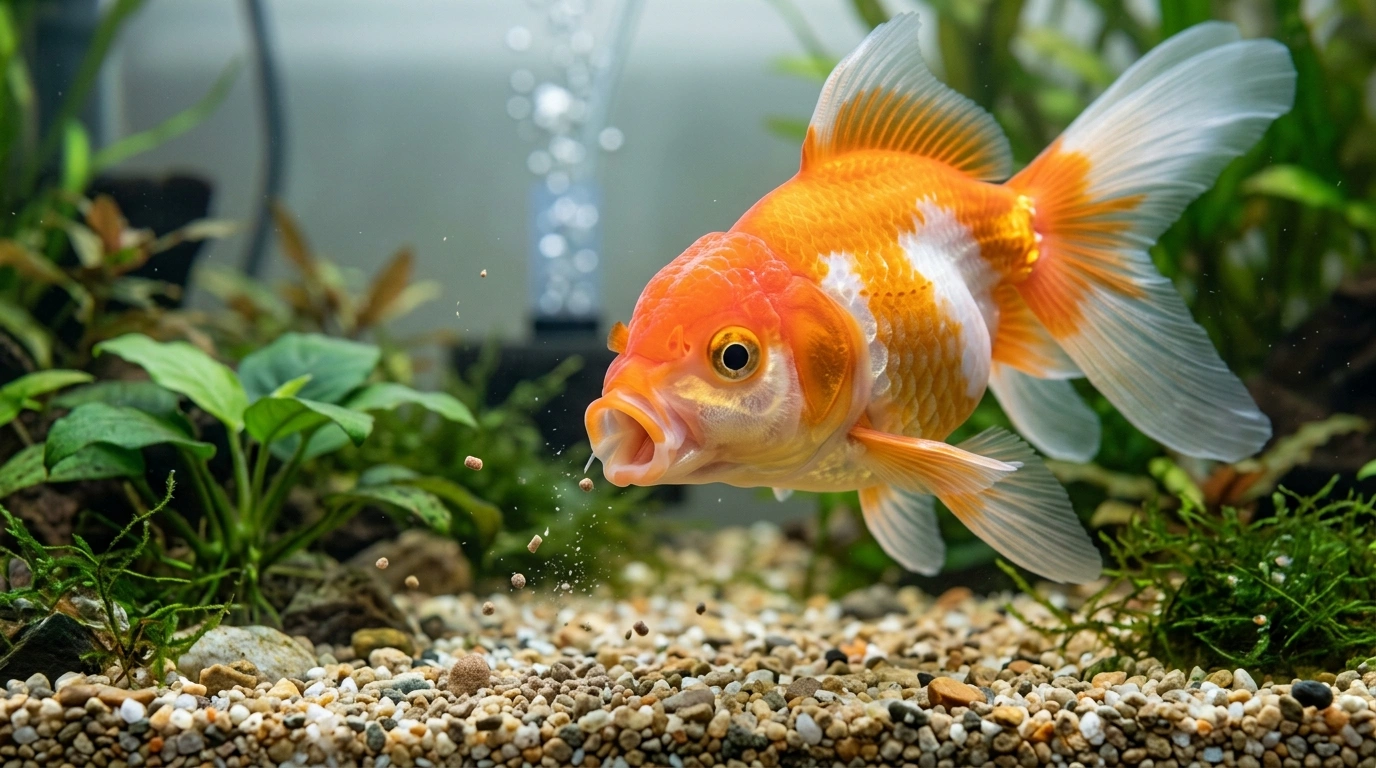
One of the most useful features of the goldfish mouth anatomy is its ability to create a pull of water inward. This is where jaw protrusion and mouth flexibility matter. When a goldfish opens its mouth, it can draw water and food inside quickly. That is why food often disappears into the mouth in a split second.
Goldfish also spend a lot of time exploring their environment through the mouth. Owners often assume the fish is hungry all the time, but sometimes it is simply investigating the tank, decor, or substrate. This is part of normal goldfish foraging behavior.
A good way to think about it is this: the goldfish mouth is a vacuum, filter, and food-entry system all in one. That single structure helps the fish gather food, test objects, and move water in the first stage of breathing.
How Goldfish Use Suction to Pull in Food
If you have ever wondered, how does a goldfish suck in food, the answer is suction feeding. This is one of the most important concepts for anyone asking how does the mouth of goldfish work.
When a goldfish sees food, it often moves toward it and opens its mouth quickly. That sudden opening creates a flow of water into the mouth. The water carries the food with it. In other words, the fish does not always “grab” food in the way people imagine. It often pulls food in by suction.
This explains why goldfish are so good at picking up floating flakes, sinking pellets, and tiny bits of food from the tank floor. It also explains why they sometimes suck in things that are not food. During normal substrate sifting, a goldfish may take in sand, tiny stones, or debris along with edible material.
This process is sometimes connected to what hobbyists describe as buccal pumping. The mouth and related structures work together to move water inward and then send it toward the gills. So even feeding and breathing are closely linked.
Here is a simple comparison:
| Goldfish Mouth Action | What It Means |
| Quick mouth opening near food | Suction feeding |
| Picking up and spitting gravel | Food sorting / substrate sifting |
| Slow rhythmic mouth movement | Normal breathing support |
| Mouth held open constantly | Possible stress or mouth problem |
This is why suction feeding in goldfish is such an important Gap keyword. Your competitors barely touched it, yet it is central to the question.
Do Goldfish Have Teeth? Yes—But Not in the Front of the Mouth
One of the most common long-tail questions is do goldfish have teeth in their mouth. The answer surprises many beginners.
Goldfish do not have obvious front teeth like dogs, cats, or humans. So when owners look into the mouth, they usually do not see teeth at all. That leads to another question: how do goldfish eat without chewing?
The answer is pharyngeal teeth.
These teeth sit farther back in the throat rather than at the front of the mouth. After the food is drawn in, the fish can move it back and process it there. So while goldfish do not chew in a human-like way, they still have a method for breaking down food.
This is why phrases like goldfish pharyngeal teeth, goldfish have no teeth in the mouth, and how goldfish chew food are such strong Gap keywords. They answer real user confusion and add topical authority to the article.
A beginner-friendly way to explain it is this:
Goldfish catch food with the mouth, but they crush and process it deeper in the throat.
That also explains why goldfish can appear to spit food out and then take it back in again. Sometimes they are repositioning it. Sometimes they are rejecting something they do not want. Sometimes they are separating edible material from debris.
So if someone asks how goldfish eat, the complete answer is not just “they swallow it.” The better answer is that they suck food in, sort it, and process it with pharyngeal teeth.
Why Goldfish Pick Up Gravel, Sand, or Debris and Spit It Out
Many owners panic when they see a goldfish mouth full of gravel. They assume the fish is choking or eating the substrate. In reality, why do goldfish spit out gravel is one of the most normal goldfish-care questions out there.
Goldfish are natural foragers. They search for food by mouthing surfaces and sifting through whatever is available. In an aquarium, that often means substrate sifting through sand, pebbles, or leftover food particles. The fish takes material into its mouth, tests it, keeps what seems edible, and spits out the rest.
This behavior is closely tied to food sorting. It is not unusual. In fact, it is a natural extension of goldfish feeding behavior.
However, there is an important difference between normal substrate sifting and danger. If the gravel is too large, too sharp, or the fish cannot spit it back out, then a problem can happen. A piece of substrate or decor may become lodged in the mouth, which can lead to a goldfish mouth stuck open.
So the behavior itself is normal, but the tank setup matters. Fine sand or appropriately sized smooth substrate is usually safer than random chunky gravel that can trap the mouth.
This is where the Gap keywords shine again:
- how goldfish sort food from gravel
- goldfish substrate sifting
- why goldfish sift substrate
- why goldfish spit out sand or gravel
These phrases directly match what owners observe in real life.
How the Goldfish Mouth Works With Breathing and Gill Movement
A goldfish does not use its mouth only for eating. It also uses mouth movement to support breathing. That is why you may see constant mouth opening and closing even when no food is around.
As the fish opens its mouth, water enters. That water then passes across the gills, where oxygen is absorbed. This is part of normal goldfish respiration. So a fish rhythmically moving its mouth is often simply breathing.
This is also why a healthy goldfish can look busy with its mouth all day long. Mouth motion by itself is not a reason to panic.
But there is a big difference between normal mouth movement and distress. A fish that shows gasping at surface, erratic movement, or rapid swimming may be struggling with oxygen deficiency in goldfish or another environmental issue. When oxygen is low, the fish may work harder to move water across the gills.
That is why the difference between normal mouth movement and gasping in goldfish is so important. Normal movement tends to be calm and steady. Stress-related breathing often looks exaggerated, desperate, or paired with unusual behavior.
If the fish is breathing hard after a missed water change, a sudden temperature shift, overfeeding, or poor aeration, the mouth may appear more active than usual. In that case, the mouth is not the root problem. It is the visible sign of a water-quality issue.
When Mouth Movement Is Normal—and When It Signals a Problem
Not every goldfish mouth open is an emergency. But not every open mouth is harmless either. Owners need to know what is normal and what is not.
Usually normal
A goldfish opening and closing its mouth during the day is usually normal. So is sucking up food, picking at decor, or mouthing sand and gravel during exploration. Mild extra activity around feeding time is also expected.
Potential warning signs
A problem may be developing if you notice:
- a goldfish mouth open and does not close
- repeated gasping at surface
- goldfish gasping and swimming erratically
- clear rapid swimming
- refusal to eat
- swelling, injury, or redness near the mouth
- a visible object stuck in the mouth
These symptoms can point to poor water conditions, ammonia buildup, nitrites in fish tank, oxygen deficiency, injury, or obstruction.
One of the useful competitor phrases here is what causes a goldfish to keep its mouth open. The answer usually falls into a few buckets: environment, blockage, or illness.
If the fish has been in a one-gallon fish bowl, missed water changes for eight days, or lives with weak aeration, mouth symptoms are more likely to be tied to stress and water quality. If it happened suddenly right after feeding or digging in gravel, obstruction becomes more likely.
So when people ask is it normal for goldfish to open and close their mouth a lot, the honest answer is: sometimes yes, but context matters.
Common Causes of an Open or Stuck-Open Goldfish Mouth
If you are asking why is my goldfish mouth stuck open, here are the most likely causes.
1. Something is lodged in the mouth
A bit of gravel, decor, or hard food may be physically stuck. This is one of the simplest explanations for a goldfish mouth open and does not close.
2. Poor water quality
Ammonia poisoning in goldfish, nitrites, and chlorine or chloramine exposure can all irritate the fish and affect breathing behavior. This is one of the most common causes of stress-related symptoms.
3. Oxygen problems
Low oxygen can lead to goldfish gasping at surface, mouth overactivity, and restlessness.
4. Injury
A fish may damage the mouth on rough decor, during aggressive feeding, or while trying to swallow something unsuitable. This is where goldfish mouth injury becomes a useful diagnostic term.
5. Infection or disease
Though less common than water-quality issues, inflammation, bacterial issues, or tissue damage may contribute. Terms like goldfish mouth fungus and goldfish mouth rot are not always the exact diagnosis, but they reflect what worried owners are searching for.
6. Stress from tank conditions
A small tank, poor tank size, infrequent maintenance, and overfeeding all create pressure on the fish.
So if someone searches how to treat goldfish open mouth syndrome, the real answer starts with cause, not guesswork.
Tank Conditions That Affect Goldfish Mouth Behavior
Good goldfish tank maintenance matters more than most beginners realize. Mouth symptoms are often one of the first clues that the environment is off.
Water quality problems can build quietly. Ammonia buildup and nitrites may rise when the tank is too small, overstocked, or poorly maintained. A fish may respond with stress, increased mouth motion, or surface gasping.
Temperature also matters. Some care advice places goldfish in a range around 62°F to 72°F, and sudden swings can stress the fish even when the number itself is not extreme. Stability matters as much as the reading.
Regular water changes are also essential. If the fish owner changes water only every four or five days in a tiny bowl, or leaves poor conditions for eight days, the fish may show visible stress. A 50% water change is often suggested in response to obvious water issues, but the right schedule depends on tank size, stocking, and filtration.
A proper dechlorinator is also critical. Tap water can contain chlorine and chloramine, both harmful to fish. Products such as water conditioner or brand-specific options like AmQuel+ are used to make tap water safer.
Some hobbyists also use 1 teaspoon of aquarium salt in specific situations, though this should be done with care and not as a cure-all. Salt does not fix ammonia, nitrites, or bad maintenance.
The bigger lesson is simple: a fish kept in a well-maintained tank with good aeration, proper feeding, stable temperature, and enough space is far less likely to develop stress-related mouth problems.
What to Do if Your Goldfish Keeps Its Mouth Open
If you notice open mouth and rapid swimming in goldfish, do not panic, but act methodically.
First, observe closely. Is there anything visible in the mouth? A stuck pellet, piece of gravel, or tank debris may explain the problem.
Second, test the water if possible. Check for ammonia, nitrites, and general quality issues. Many cases of goldfish stressed after missed water change come back to water, not disease.
Third, increase aeration if oxygen seems low. Better surface movement can help quickly in some situations.
Fourth, think about recent events. Did you overfeed? Add untreated tap water? Skip maintenance? Rearrange sharp decor? These clues matter.
Fifth, watch for other symptoms. A fish that cannot eat, has swelling, or remains abnormal after water correction may need experienced help.
A short case-study style example makes this easier to picture:
A goldfish in a tiny bowl begins rapid swimming, keeps its mouth partly open, and gasps near the surface after several missed cleanings. The owner first assumes a disease problem. But after a large safe water change, dechlorinated replacement water, and better aeration, the symptoms improve. In this case, the goldfish mouth problem was really a water quality issue.
That is why how to tell if goldfish mouth behavior is normal depends on the full picture, not one symptom alone.
Quick Goldfish Mouth FAQ
Do goldfish have lips?
Yes, in a simple sense they do. Their mouth edges help them form the opening used for feeding and suction.
Do goldfish chew food?
Not with front teeth. They use pharyngeal teeth farther back in the throat.
Why do goldfish look like they are kissing the glass?
They may be exploring surfaces, searching for food, or reacting to reflections. It is often normal.
Why do goldfish spit out gravel?
Because substrate sifting is part of normal foraging. They test material and spit out what is not edible.
Is mouth opening always a sign of low oxygen?
No. Normal breathing involves mouth movement. But exaggerated motion plus gasping at surface can signal oxygen trouble.
Can a goldfish injure its mouth on decor?
Yes. Rough or sharp decorations can contribute to a goldfish mouth injury.
Conclusion
So, how does the mouth of goldfish work? In the simplest terms, it works as a feeding, sorting, and breathing tool. A goldfish uses its mouth to pull in food by suction, test objects in the tank, move water toward the gills, and send food back to pharyngeal teeth for processing.
That is why normal goldfish mouth function can look unusual to beginners. A fish may suck in pellets, mouth the substrate, or spit out gravel without anything being wrong. But if you see a goldfish mouth stuck open, constant distress breathing, rapid swimming, or signs of poor water conditions, the mouth may be showing you that the fish is under stress.
In other words, the mouth is not just where food goes in. It is one of the clearest windows into your goldfish’s overall health. Understanding that makes you a better, calmer, and more confident fish owner.
Disclaimer: The information in this article is based on general fishkeeping knowledge and is intended to help beginners understand goldfish mouth behavior. It is not a substitute for professional veterinary guidance. When in doubt about your fish’s health, always seek expert advice.