

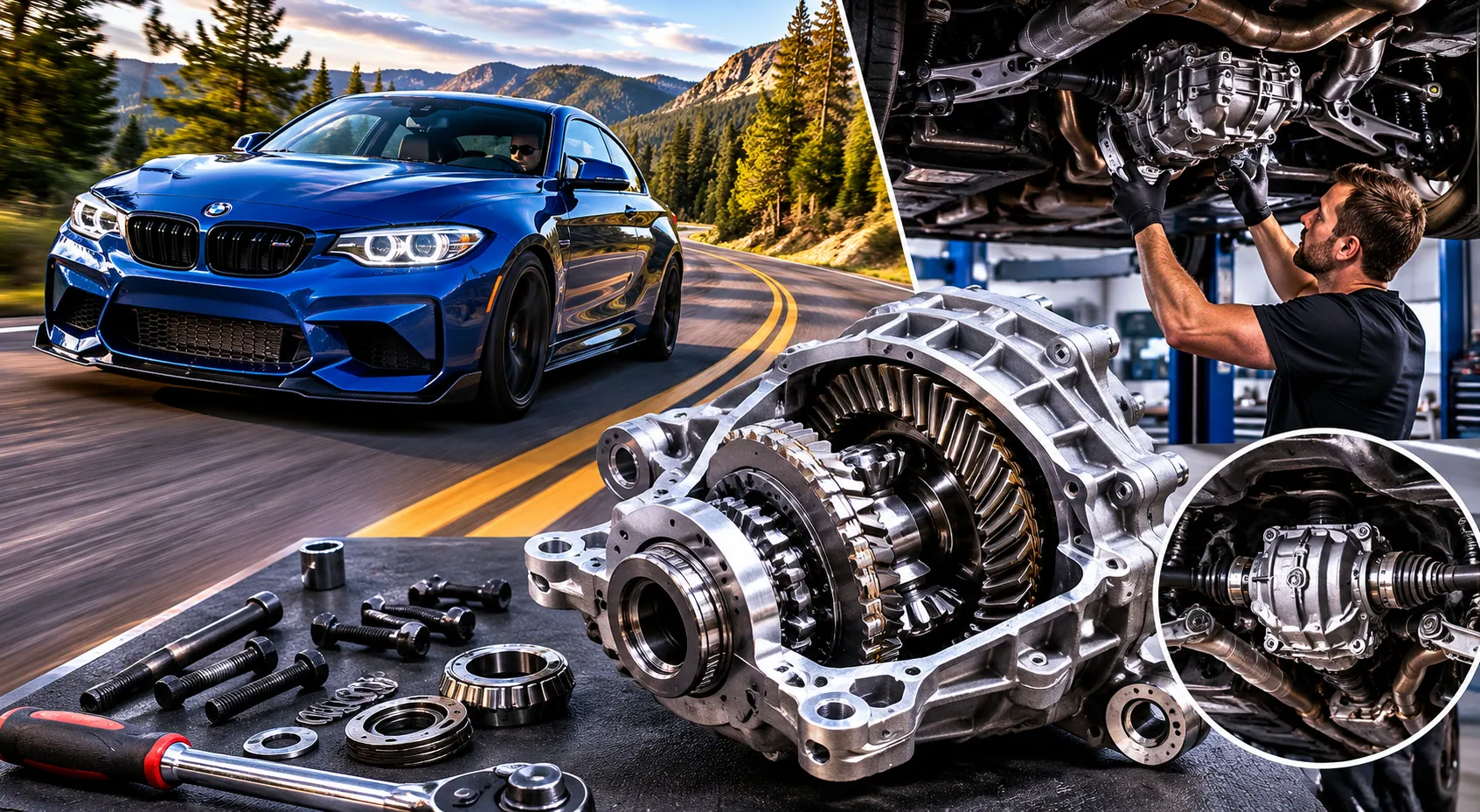
is the m performance lsd worth it is one of the most common questions BMW owners ask when they start pushing a rear-wheel-drive BMW harder than the factory open differential can comfortably handle. The short answer is: yes, the BMW M Performance LSD is worth it if you enjoy spirited driving, track days, autocross, drifting, or you own a tuned B58/N55 car that struggles to put power down. But if your BMW is mostly a relaxed daily commuter and you rarely accelerate hard out of corners, the value is less obvious.
The M Performance limited slip differential is not a flashy cosmetic mod. You do not see it every time you walk up to the car. But you feel it when the rear tires start working together, when the car exits a corner with more confidence, and when wheelspin becomes more controlled instead of messy. For cars like the BMW 340i, M240i, M140i, and M235i, it can be one of the most meaningful drivetrain upgrades available.
Quick Verdict: Yes, But Only for the Right BMW Owner
The BMW M Performance LSD is worth it for drivers who want better rear traction, sharper corner exit, and a more connected rear-wheel-drive feel. It is especially valuable if you drive a BMW 340i, M240i, M140i, or M235i hard on back roads, track days, or autocross events.
For a casual daily driver, though, the answer is more balanced. If you mostly sit in traffic, cruise on highways, and never feel the stock open diff struggle, the upgrade may feel expensive for the difference it makes. When parts and labor can push the total cost into the multi-thousand-dollar range, value matters.
| Driver Type | Is It Worth It? | Why |
| Casual commuter | Maybe not | You may rarely feel the difference |
| Spirited road driver | Yes | Better grip and confidence out of corners |
| Track/autocross driver | Strong yes | More predictable rear-end behavior |
| Tuned B58/N55 owner | Strong yes | Helps put power down more cleanly |
| Drifting enthusiast | Yes | Easier, more controlled oversteer |
| Budget-focused owner | Depends | Tires, maintenance, or suspension may come first |
So the real verdict is simple: the M Performance LSD is worth it when your driving style exposes the limits of the stock open differential.
What the BMW M Performance LSD Actually Does
The BMW M Performance Limited Slip Differential is a mechanical LSD designed to help both rear wheels share torque more effectively. In many BMW enthusiast discussions, it is commonly associated with a Drexler-style plate limited-slip differential, depending on the exact model and application.
A normal open differential allows the rear wheels to rotate at different speeds, which is useful when turning. The problem is that when one rear tire loses grip, an open diff can send too much usable power to the wheel that is already spinning. That is why some owners describe the stock setup as a “one-wheel peel” when accelerating hard out of a bend.
A limited-slip differential reduces that problem. Instead of letting one wheel waste power, it helps transfer torque toward the wheel with more grip. In real driving, that means better traction, less messy wheelspin, and more control when you apply throttle.
Some competitor discussions mention figures such as 30% lockup on acceleration and 9% lockup on deceleration for certain M Performance applications. In simple terms, this means the diff can partially lock under power to help the rear wheels work together, while remaining smooth enough for road use.
This is why the upgrade matters. The M Performance diff does not simply add power. It helps your BMW use the power it already has.
M Performance LSD vs Open Differential: The Real Difference
The easiest way to understand the difference is to imagine accelerating out of a tight corner. With an open differential, the inside rear wheel often becomes lighter because weight transfers to the outside of the car. If that inside tire loses grip, it can spin first, and the car wastes torque.
With the BMW M Performance LSD, the rear axle behaves more intelligently. The diff helps send torque to the wheel that still has grip, improving rear wheel traction and making the car feel more stable under throttle.
This is different from brake-based traction control or BMW’s electronic systems such as DSC. Electronic traction control can reduce engine power or apply braking to control slip. That helps safety, but it can also feel intrusive when driving quickly. A mechanical LSD works directly through the rear differential, so the power delivery feels more natural and progressive.
That is why many owners compare BMW e-diff vs mechanical LSD and prefer the mechanical solution for performance driving. The car does not just cut power; it hooks up better.
The difference is not always dramatic during slow commuting. But during spirited driving, wet road acceleration, track days, and corner exit, the LSD makes the rear of the car feel more planted, predictable, and useful.
How Much Difference Does It Make in Everyday Driving?
A common question is: how much difference does M Performance LSD make in everyday driving? The honest answer is that it depends on how you drive.
If your daily driving is gentle, the M Performance LSD everyday driving difference may be subtle. You may not feel it while cruising at steady speeds, parking, or rolling through traffic. A limited-slip differential is not like a loud exhaust or a tune that changes the car every second.
But the moment you accelerate harder out of a roundabout, take a highway ramp quickly, pull away on a wet road, or apply throttle mid-corner, the difference becomes clearer. The car feels less like it is wasting power through one tire and more like it is pushing from the rear axle as a unit.
For a 2017 BMW 340i, BMW M240i, or M140i, this is especially noticeable because these cars have enough torque to expose the weakness of the stock open diff. A tuned car makes the difference even bigger. More torque means more opportunity for the inside wheel to spin, especially in lower gears.
So, is M Performance LSD worth it for daily driving? It is worth it if your daily driving includes fun roads, hard acceleration, wet conditions, or occasional aggressive cornering. If your daily drive is purely calm commuting, it may not be the best first upgrade.
Where You Feel It Most: Traction, Wheelspin, and Corner Exit
The biggest benefit of the BMW M Performance LSD is not straight-line horsepower. It is usable traction. The car can put power down more effectively because both rear tires contribute instead of one tire doing most of the work.
You feel this most in three areas: corner exit, wheelspin control, and rear-end stability.
When exiting a corner, an LSD lets you apply throttle earlier and more confidently. Instead of the inside rear tire spinning and the car feeling loose or hesitant, the rear axle loads up more evenly. This gives the driver a stronger sense of connection.
It also helps reduce uncontrolled wheelspin. That does not mean the car will never spin the tires again. A powerful B58 BMW can still light up the rear tires if you ask too much from them. But the spin is usually more predictable and balanced.
The LSD can also improve throttle steering. In a rear-wheel-drive car, careful throttle input can help rotate the car. With an open diff, that rotation can feel inconsistent. With a mechanical LSD, the rear end often feels more natural and easier to manage.
This is why terms like rear traction, put down power, corner exit speed, apex, hairpins, and sweepers appear so often in owner discussions. The M Performance LSD makes the car feel more like a proper performance BMW.
Is It Worth It for Track Days, Autocross, and Spirited Driving?
For track days, autocross, and serious spirited driving, the M Performance LSD becomes much easier to justify. These are the situations where the stock open differential is most likely to feel limiting.
On track, you repeatedly ask the rear tires to handle braking, cornering, and acceleration. If one rear tire loses grip on corner exit, the open diff can waste time and momentum. With a limited-slip differential, the car can drive out of corners with more stability and confidence.
In autocross, the benefit is also strong because the course often includes tight turns, quick transitions, and low-speed exits. These are exactly the moments when an open diff can spin the inside rear wheel.
For spirited road driving, the value depends on how hard you drive. If you enjoy twisty roads, mountain routes, canyon driving, or fast back roads, the M Performance diff can make the car feel more alive. You are not just going faster; you are getting a cleaner, more predictable response from the rear axle.
However, this is still a public-road upgrade. The article should be clear: the safest place to explore the full benefit of an LSD is on closed courses, track days, or legal motorsport events.
Is It Worth It for Tuned BMWs Like the M140i, M240i, and 340i?
The more torque your BMW makes, the more valuable the LSD becomes. That is why the upgrade is popular with owners of the BMW M140i, M240i, M235i, and 340i, especially tuned examples.
A Stage 2 M140i or tuned B58 car can produce enough torque to overwhelm the stock open differential easily. Even a stock BMW M240i or F30 340i can struggle for clean traction in lower gears, especially in wet weather or on uneven roads.
The BMW B58 and BMW N55 engines are strong platforms, and tuning them often creates a new traction problem. More power is fun, but without grip, the car can feel messy. The M Performance LSD helps turn that extra torque into forward motion.
For a tuned BMW, the LSD is often not just a handling upgrade. It becomes a power delivery upgrade. It helps the car feel less like it is fighting itself and more like it is using the rear axle properly.
If your BMW is stock and you drive gently, the upgrade is optional. If your BMW is tuned and regularly spins the inside rear tire, the LSD can feel like the missing piece.
Fitment: Manual vs Automatic, xDrive, and Final Drive Ratios
Before buying a BMW M Performance LSD, fitment matters. You should not buy one simply because it came from a similar-looking BMW. Compatibility can depend on the chassis code, engine, transmission, final drive ratio, production year, and BMW part number.
For example, a F30 340i LSD, F22 M240i LSD, or M140i M Performance diff may not all share the same fitment. A 6MT manual transmission car and a ZF 8HP automatic transmission car may use different ratios or assemblies.
This is why a proper M Performance LSD fitment guide should always mention a BMW VIN check. Matching the VIN, part number, and final drive ratio helps avoid expensive mistakes.
The same applies to xDrive compatibility. Many discussions around M Performance LSD compatible with xDrive are complicated because all-wheel-drive BMWs use a different drivetrain layout. Some xDrive cars may have options, but the fitment, cost, and practical need can be different from a rear-wheel-drive car.
In simple terms: verify fitment before purchase. The LSD can be a great upgrade, but the wrong differential can become a very expensive problem.
M Performance LSD vs Quaife, Wavetrac, and Aftermarket LSDs
The BMW M Performance LSD is not the only option. Many owners also compare M Performance LSD vs Quaife, M Performance LSD vs Wavetrac, and other aftermarket choices like MFactory or OS Giken.
The M Performance LSD’s biggest strength is its OEM BMW appeal. It is a genuine BMW-oriented upgrade, often easier to explain to buyers, dealers, and specialists. It also fits the car’s character well when correctly matched.
Aftermarket options can be attractive for different reasons. Quaife is often associated with smooth road manners and torque-biasing behavior. Wavetrac is popular with performance-focused street and track users. MFactory may appeal to budget-conscious buyers. OS Giken is often considered a more serious high-performance option, but cost and setup can be more involved.
| Option | Best For | Main Advantage | Main Trade-Off |
| BMW M Performance LSD | OEM-minded owners | Genuine BMW feel and fitment | Higher cost |
| Quaife | Street performance | Smooth torque-biasing behavior | Not OEM |
| Wavetrac | Street/track use | Strong aftermarket reputation | Fitment research needed |
| MFactory | Budget builds | Often cheaper | Less OEM appeal |
| OS Giken | Serious builds | High tuning potential | Expensive and more complex |
For many BMW owners, the question is not whether aftermarket LSDs are bad. They are not. The question is whether the OEM BMW LSD vs aftermarket LSD advantage is worth paying for. If you value factory-style integration, resale confidence, and simplicity, the M Performance option is compelling.
Cost, Installation, and Value for Money
Cost is the biggest reason people hesitate. The M Performance LSD installation cost can be significant, especially when you include parts, fluid, labor, and possible shop charges. Competitor discussions mention examples such as around $1000 installation labor, a little over $3K, and about $2,700 installed, depending on the car, region, and parts source.
That is why this upgrade should be judged as a cost-benefit decision, not an impulse purchase. If your tires are old, your suspension is worn, or your maintenance is behind, those should come first. An LSD cannot fix bad tires or neglected service.
However, if the car is already healthy and you want a deeper performance upgrade, the M Performance LSD can be excellent value. Unlike a simple power tune, it changes how the car uses power. It improves the driving experience rather than only chasing numbers.
A BMW dealer installation may cost more but can offer peace of mind for some owners. An independent BMW specialist may be cheaper and equally skilled, especially if they regularly install differentials. Either way, correct installation is essential.
The M Performance LSD is not cheap. But for the right driver, it feels like money spent on the car’s core personality.
Maintenance, Fluid Service, and Long-Term Reliability
A mechanical LSD is a hardworking drivetrain part, so maintenance matters. Owners should pay attention to BMW LSD fluid service, proper differential oil, and any recommended break-in procedure after installation.
Some limited-slip differentials can produce mild noise, chatter, or clunking if the wrong fluid is used or if installation is poor. The M Performance unit is generally designed for road-friendly behavior, but it still needs proper care.
Before installation, ask the shop about BMW differential fluid change, break-in guidance, and future service intervals. Also ask whether the unit is new, used, rebuilt, or removed from another car.
A used M Performance LSD can be worth considering, but only if the part number, ratio, condition, and history are clear. Saving money upfront is not helpful if the diff is worn, noisy, or incompatible.
For long-term reliability, the best approach is simple: buy the correct part, use the correct fluid, install it properly, and service it sensibly.
Does It Help in Rain, Snow, or Winter Driving?
The M Performance LSD can help in rain, wet conditions, and low-grip situations because it improves how torque is shared across the rear axle. If one rear wheel starts to slip, the diff can help the other wheel contribute more effectively.
However, it is not magic. It does not replace winter tires, careful throttle input, or DSC active safety systems. In snow or icy conditions, tires matter more than almost any drivetrain upgrade.
For wet road traction, the LSD can make a rear-wheel-drive BMW feel more predictable when accelerating. It can also reduce the sudden inside-wheel spin that happens when pulling away from junctions or exiting corners.
But drivers should not confuse better traction with unlimited grip. The LSD helps you use available grip better. It does not create grip where none exists.
For winter driving, the best setup is still: good tires, smooth inputs, working stability control, and realistic expectations.
Warranty, Resale Value, and the OEM BMW Advantage
One reason owners choose the BMW M Performance LSD over aftermarket options is the OEM BMW advantage. A genuine BMW-oriented part can feel easier to justify when it comes to documentation, resale, and ownership confidence.
A buyer looking at your modified BMW may be more comfortable seeing a genuine BMW part than an unknown aftermarket differential. That can help with resale flexibility, especially if the car is otherwise clean and well maintained.
Warranty impact depends on region, dealer, installation method, and vehicle status. A dealer-installed accessory may be viewed differently from a used differential installed by an unknown shop. That does not mean every warranty concern disappears, but the M Performance LSD generally has a cleaner ownership story than many aftermarket upgrades.
For owners who want a balanced car rather than a heavily modified build, this matters. The M Performance LSD keeps the car feeling like a BMW, only sharper.
Final Verdict: Should You Buy the M Performance LSD?
So, is the M Performance LSD worth it? Yes, if you are the kind of BMW owner who notices traction limits and wants the rear of the car to feel more controlled, more predictable, and more performance-focused.
It is especially worth it for BMW 340i, M240i, M140i, and M235i owners who drive hard, attend track days, enjoy autocross, or run a tuned B58/N55 setup. In those cases, the upgrade helps reduce wasted wheelspin, improves corner exit, and makes the car feel more complete.
It is less worth it if you only commute gently and never push the car. For that driver, better tires, maintenance, brakes, or suspension may deliver more noticeable value first.
The M Performance LSD is not the cheapest BMW upgrade, but it is one of the most meaningful for drivers who care about how the car behaves at the limit. It does not just make the car faster. It makes the car feel more capable, more balanced, and more like the rear-wheel-drive BMW many owners wanted from the start.
FAQs About the M Performance LSD
Is the M Performance LSD worth it for daily driving?
Yes, but mostly for drivers who enjoy spirited daily driving. If your daily route includes roundabouts, ramps, wet roads, or back roads, you will feel the benefit more often. For calm commuting, the difference may be subtle.
Does the M Performance LSD reduce wheelspin?
Yes, it can reduce uncontrolled one-wheel spin by helping both rear wheels share torque. It does not eliminate wheelspin completely, especially on tuned cars, but it makes traction more predictable.
Is the M Performance LSD better than an open differential?
For performance driving, yes. An open differential is fine for normal use, but a mechanical LSD gives better torque transfer, better rear traction, and more confidence under throttle.
Is the M Performance LSD worth it on a BMW 340i, M240i, or M140i?
Yes, these are some of the best candidates. A BMW 340i LSD, M240i M Performance LSD, or M140i M Performance diff makes sense because these cars have enough torque to expose the stock diff’s weaknesses.
Should I buy a used M Performance LSD?
A used unit can be worth it if the BMW part number, final drive ratio, condition, and service history are correct. Avoid unknown units with unclear mileage, damage, noise, or poor fitment information.
Does the M Performance LSD work with xDrive?
It depends on the model and drivetrain. xDrive compatibility is more complex than rear-wheel-drive fitment, so always verify by VIN, part number, and specialist advice before buying.
Disclaimer: This article is for informational purposes only and does not constitute automotive, mechanical, or professional driving advice. Vehicle performance, installation costs, compatibility, and driving benefits may vary by BMW model, modifications, and driving conditions. Always consult a qualified BMW technician or performance specialist before purchasing or installing a limited-slip differential.