

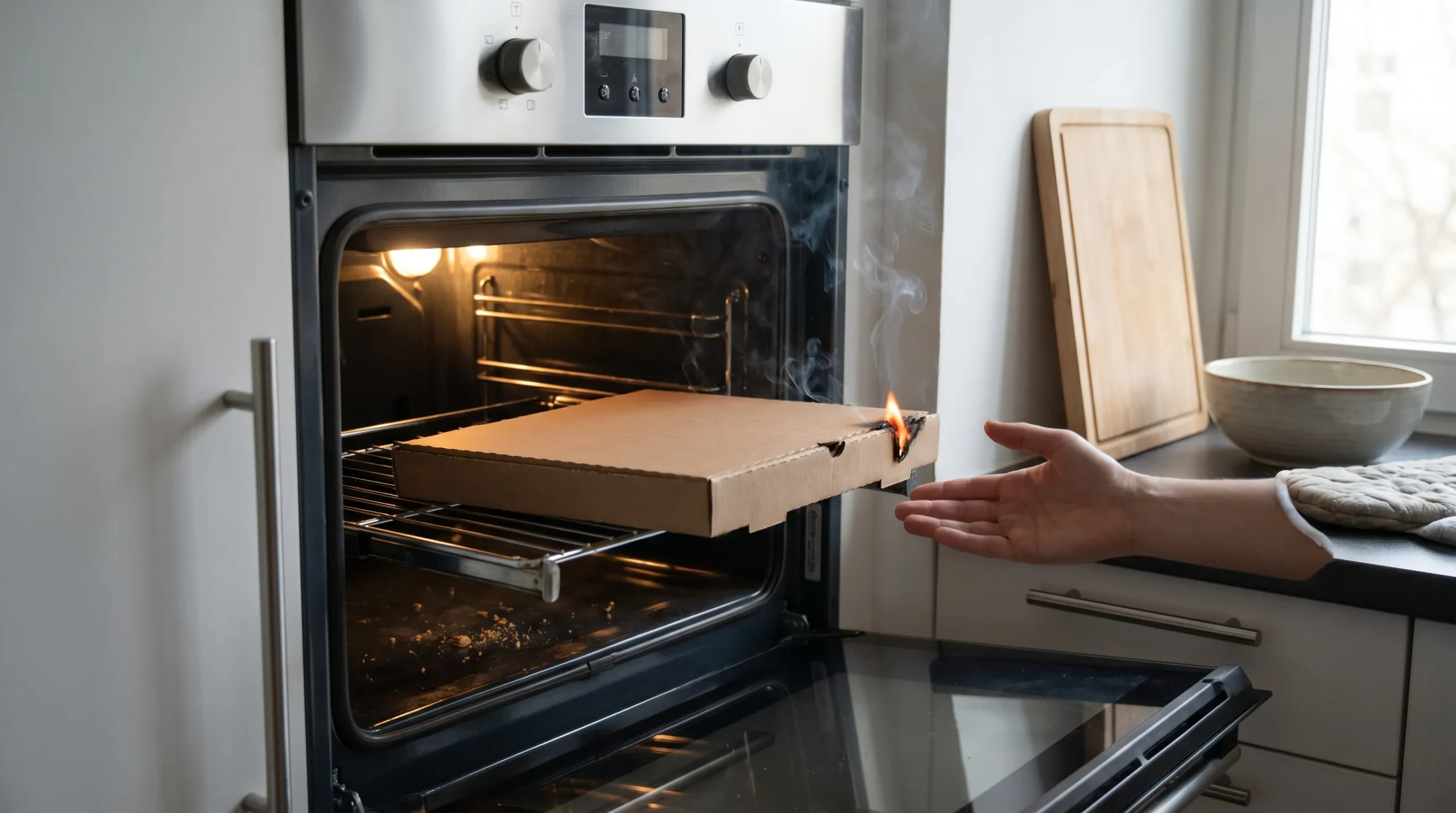
Can you put cardboard in the oven? In most cases, no—and that is the safest answer to remember. Ordinary cardboard is not oven-safe, and experts warn it can scorch, smolder, and even catch fire, especially as temperatures climb. The confusion usually starts with everyday situations: you want to keep a pizza box warm, reheat leftovers, or bake a frozen pizza without moving it to a pan. But convenience does not make the material safe. Food packaging is regulated for specific conditions of use, which means a package that is fine for carrying food is not automatically approved for oven heating.
A better approach is simple: remove the cardboard, follow the package directions, and transfer the food to an oven-safe dish, baking sheet, pizza stone, or directly to the oven rack if the product instructions allow it. That keeps you away from unnecessary fire hazard risk and usually gives you better texture too—especially if you are reheating pizza and want a crispy crust instead of a soggy bottom.
Is cardboard oven-safe?
As a general rule, cardboard in the oven is unsafe. Martha Stewart’s expert-sourced guidance states plainly that you should not put cardboard in an oven, and it notes that cardboard may catch fire at temperatures above 400°F. Even when the oven is set lower, that does not make it a good idea. Ovens have hot spots, heating elements cycle on and off, and grease or coatings on the material can make the risk worse.
That matters because many people search for phrases like “is cardboard safe in the oven,” “is cardboard oven safe,” or “can cardboard go in the oven at a low temperature?” The problem is that these questions assume heat tolerance works in a neat, predictable way. In reality, ovens are not designed for corrugated cardboard, paperboard, or pizza cardboard boxes. Packaging may be food-safe for transport or short contact with food, but that is very different from repeated exposure to oven heat. FDA guidance makes that distinction clear by treating food-contact materials according to their intended conditions of use, including whether they are meant to be reheated in the container.
Why cardboard in the oven is dangerous
The biggest reason is the simplest one: cardboard is flammable. Once it dries out and heats up, it can brown, scorch, smoke, or ignite. If the cardboard has absorbed oil from pizza or other food, the danger increases. That is why terms like cardboard ignition temperature, cardboard fire hazard, and flammable materials show up so often around this topic. Expert advice from Martha Stewart’s reporting is especially clear: even if the oven is not blazing hot, cardboard still does not belong there.
There is also a second issue people often overlook: chemicals, inks, glues, and grease-resistant coatings. Some food-contact substances are legally authorized only for very specific uses. FDA notes that food-contact materials are evaluated based on how they are intended to be used, and it separately explains that some PFAS substances have historically been authorized for applications such as grease-proof agents for paper food packaging. That does not mean every cardboard item is meant for oven heat. It means you should not assume that because a box touched your food, it is automatically safe for baking or reheating.
A third problem is food quality. Cardboard blocks airflow, traps some moisture, and can interfere with how food reheats. That is why frozen pizza cardboard, cardboard under frozen pizza, and pizza box in the oven can leave you with a softer crust and a less evenly heated slice. In other words, the workaround is not just risky—it is often worse for the food.
Can you put a pizza box in the oven?
This is one of the most common versions of the question, and the answer is still no. A pizza box is designed for transport, not for baking or reheating. It helps keep pizza warm for a short time after pickup or delivery, but that is very different from sitting inside a hot oven. Martha Stewart specifically advises keeping cardboard away from the oven, even when you are only trying to warm pizza gently, and recommends transferring the pizza to a pizza stone or skillet instead.
The misunderstanding is easy to see. People think, “The pizza came hot in the box, so maybe the box can go back into the oven.” But hot food sitting in a box for a short period is not the same as heating that box inside an appliance that can run at 300–350°F, 400°F, or higher. Those are two different situations, and only one of them involves direct oven exposure. FDA’s conditions-of-use framework is useful here: material safety depends on how the material will be used, not just whether it has touched food before.
So if you are wondering “can you reheat pizza in the box?” or “is it safe to put a pizza box in the oven?”, the smart move is to take the pizza out first. That gives you safer reheating and usually a better bite.
Can you leave frozen pizza cardboard under the pizza?
Again, no. The cardboard disk or support board under a frozen pizza is there to support the product in the freezer and during transport. It is not there to act like a pizza pan. If you leave it underneath during baking, you risk poor texture, uneven cooking, and unnecessary heat exposure to a material that was not meant to be used that way.
This is one reason phrases like “does frozen pizza cardboard need to be removed before baking” and “should you use the cardboard under frozen pizza in the oven” are so common. People see the cardboard touching the pizza and assume it belongs in the oven. In practice, package directions are what matter. If the box says remove the cardboard, remove it. That is the safest and most reliable rule. FDA’s food-contact guidance supports that broader idea because intended use is what determines whether a material is suitable for reheating in the container.
There is also a quality reason to remove it: pizza tends to bake better on a baking sheet, pizza stone, or directly on the oven rack when the instructions allow it. Those options are much better for getting a crispy crust and avoiding an undercooked bottom.
Why frozen pizza comes with cardboard in the first place
This part trips people up because the cardboard feels “official.” If the manufacturer included it, why can’t you bake on it? The answer is that the insert is usually there for shape, stability, stacking, and transport. It helps the pizza survive freezing, packaging, and shipping without falling apart. That is a packaging job, not a cooking job.
That distinction is useful for SEO and for readers because it answers the hidden question behind the main keyword. Many searchers are not really asking whether all cardboard can go in the oven. They are asking whether the cardboard that came with the food has some special exception. Usually, it does not.
Microwave-safe vs oven-safe: not the same thing
This is one of the biggest content gaps on the current SERP. Many people assume that if packaging is microwave-safe, food-safe, or just “meant for food,” it must also be okay in the oven. That is not true. FDA’s material rules are built around conditions of use, and those conditions are not interchangeable. A container may be suitable for refrigerated storage, room-temperature storage, or limited reheating in the container without being suitable for full oven exposure.
FDA also explains that microwaves work differently from conventional ovens. Microwave energy passes through materials like paper, glass, and some plastics, while metal reflects it and food absorbs it. That does not mean cardboard is universally microwave-safe, and it definitely does not mean it is oven-safe. It simply means microwave heating and oven heating expose materials to very different kinds of stress.
So the best rule is this: food-safe does not mean oven-safe, and microwave-safe does not mean oven-safe. If the package does not clearly say it can go in the oven, do not guess.
The safest way to reheat pizza without the box
If your real goal is not cardboard but how to reheat pizza safely, the solution is straightforward. Move the pizza to a baking sheet, pizza stone, cast iron skillet, or directly to the oven rack if that matches the product instructions and you do not mind a firmer bottom crust. These are all better choices than cardboard because they are made for heat. Martha Stewart specifically recommends moving pizza to a pizza stone or skillet.
For leftovers, USDA says reheated food should reach 165°F as measured with a food thermometer. That is the food-safety benchmark, and it matters more than trying to warm food inside original packaging. If you are keeping food hot before serving, USDA’s “danger zone” guidance says hot food should stay at 140°F or above.
Here is a simple comparison:
| Reheating option | Safe for oven use | Best for texture | Notes |
| Cardboard / pizza box | No | Poor | Fire risk; not designed for oven heat |
| Baking sheet | Yes | Good | Easy, common, dependable |
| Pizza stone | Yes | Excellent | Great for crisp crust |
| Oven rack | Yes, if instructions allow | Excellent | Crisp bottom, but can drip |
| Cast iron skillet | Yes | Very good | Great for slices and browning |
That table also helps answer long-tail queries like “what to use instead of cardboard in the oven,” “safest way to reheat leftover pizza,” and “direct-on-rack vs pan for reheating pizza.”
Can takeout boxes, bakery boxes, or other paper products go in the oven?
Usually, you should treat these the same way: do not put them in the oven unless the manufacturer clearly says they are oven-safe. A takeout container, bakery box, or other paperboard package may be fine for carrying food home, but that does not mean it can handle oven heat. FDA’s food-contact rules again come back to intended use, and USDA’s takeout and leftovers guidance points consumers toward proper reheating practices rather than improvised packaging shortcuts.
This is especially important for containers with inks, adhesives, liners, or grease-resistant coatings. Even when the fire risk seems low, the packaging still may not be approved for that kind of heating. If you are unsure, the safest move is to transfer food to an oven-safe dish.
Quick safety checklist
When people search “can you put cardboard in the oven,” they usually want a fast answer they can act on immediately. Here it is.
If it is cardboard, take it out.
If it came with food, read the package directions.
If you need to reheat it, move the food to an oven-safe container.
If it is leftovers, reheat the food to 165°F.
If you are holding food hot before serving, keep it at 140°F or above.
That simple routine covers most edge cases, including pizza boxes, frozen pizza cardboard, and takeout packaging.
A short real-world example
Imagine someone orders pizza late at night and wants to keep the last few slices warm. Instead of transferring them, they slide the pizza cardboard box into the oven at a “low” temperature because it feels harmless. But that setup creates three problems at once: the box is still flammable, the grease on the bottom can worsen the risk, and the crust usually reheats worse than it would on a baking tray or pizza stone. The safer and smarter move is to remove the slices, place them on a heat-safe surface, and warm them until the food is hot. That solves the real problem without turning packaging into cookware.
FAQ
Can you put a pizza box in the oven at a low temperature?
It is still not recommended. Expert guidance says cardboard should be kept away from the oven, and the fact that the temperature is lower does not make the box oven-safe.
What temperature does cardboard catch fire?
Sources vary, but expert commentary cited by Martha Stewart says cardboard may catch fire above 400°F. That is one reason this is a poor risk to take.
Can you put frozen pizza cardboard in the oven?
In general, no. Remove the support cardboard unless the product specifically says otherwise. Follow the package directions.
Can cardboard go in a toaster oven?
You should treat a toaster oven the same way: unless the packaging explicitly says it is oven-safe, do not put cardboard in it. The heating environment is still not what ordinary cardboard is designed for.
Is parchment paper safer than cardboard in the oven?
Yes, parchment paper is made for baking use within its stated temperature limits, while cardboard is not. Always check the parchment brand’s instructions, but it is far more appropriate for oven use than a cardboard box.
Is food-safe packaging always safe to heat?
No. Food-safe, microwave-safe, and oven-safe are not the same thing. FDA evaluates food-contact materials based on specific conditions of use.
Conclusion
The best answer to can you put cardboard in the oven is still the simplest one: don’t do it. Ordinary cardboard, pizza boxes, and most frozen pizza cardboard are not designed for oven heat. They can create a fire hazard, expose food to unsuitable packaging materials, and often make the food reheat worse anyway.
If you want the safe alternative, it is easy: remove the cardboard, transfer the food to a baking sheet, pizza stone, cast iron skillet, or another oven-safe dish, and reheat leftovers to 165°F. That gives you better texture, better safety, and a cleaner answer than trying to make packaging do a job it was never meant to do.
Disclaimer:
This article is for general informational purposes only and is not a substitute for professional food safety guidance. Ordinary cardboard, pizza boxes, and most frozen pizza support boards are not oven-safe and can pose fire hazards or release unsafe chemicals when heated. Always transfer food to an oven-safe dish, baking sheet, pizza stone, or skillet and reheat to recommended temperatures to ensure safety and proper food quality.