

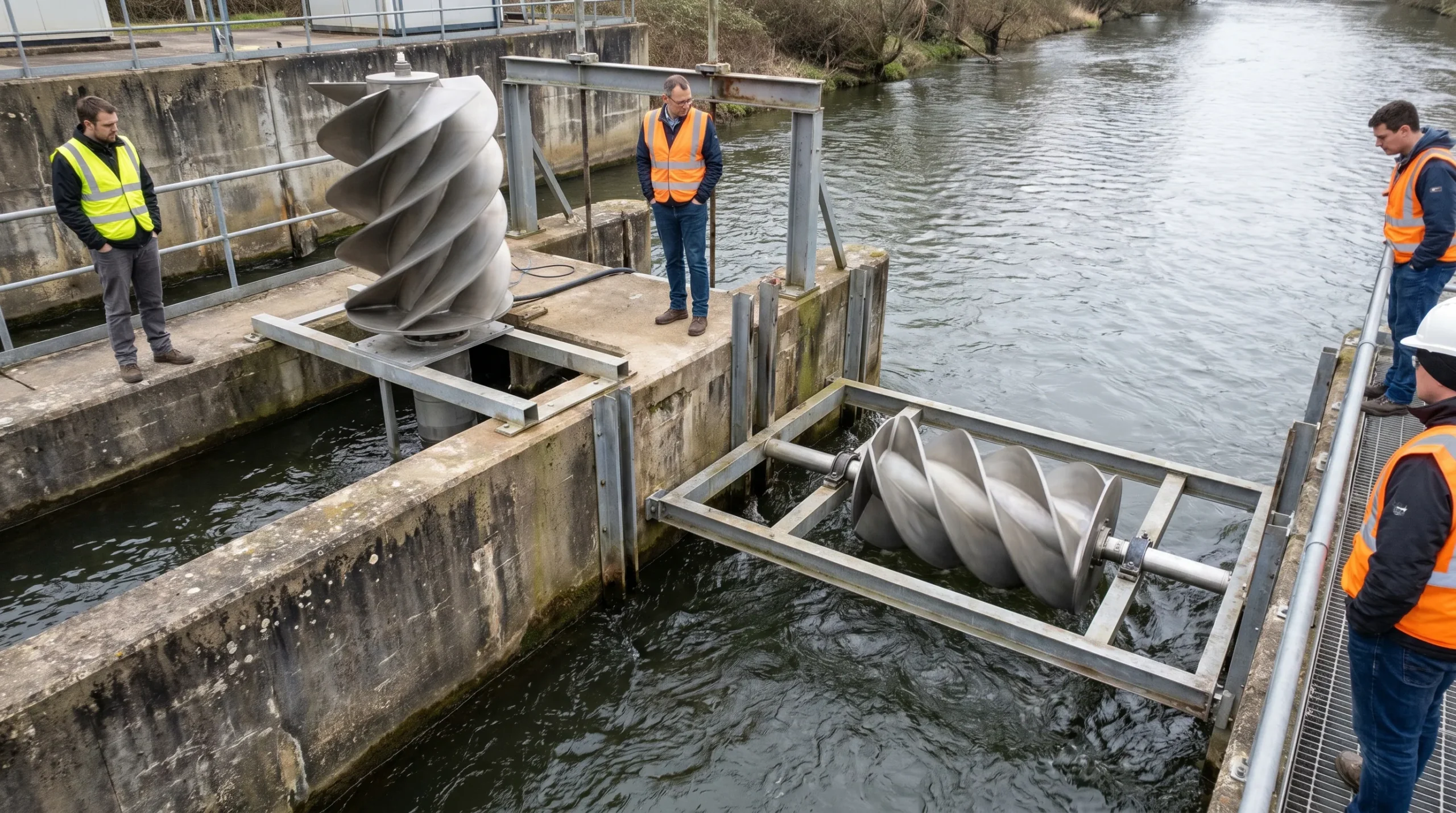
Which of the turbine can be mounted vertically and horizontally? The correct answer is the Gorlov turbine, also called the Gorlov helical turbine. It is a non-directional, helical-blade turbine derived from the Darrieus turbine concept, and it can be installed with a vertical or horizontal axis as long as the axis stays perpendicular to the flow. That design flexibility is what makes it stand out from more conventional turbine types.
A lot of people search this query as an engineering MCQ, so they want the answer fast. But the better question is not just what the answer is. It is why the answer is correct. Once you understand how the Gorlov helical turbine works, the vertical-and-horizontal mounting idea becomes much easier to remember.
Before we go deeper, here is the quick version.
| Question | Correct answer | Why it works |
| Which turbine can be mounted vertically and horizontally? | Gorlov turbine | Its helical design and axis-perpendicular-to-flow setup let it operate in either orientation, provided the flow relationship stays correct. |
That is the short answer. Now let’s unpack the engineering behind it in a way that is easy to understand.
What Is a Gorlov Turbine?
The Gorlov turbine is a vertical-axis, lift-based turbine that was developed from the Darrieus turbine family. Its most distinctive feature is its helical blades, which wrap around the rotor in a spiral shape rather than remaining straight. This helical form helps smooth the rotation and reduces the torque fluctuations that older straight-bladed designs often struggle with.
In technical terms, the Gorlov helical turbine is commonly discussed in hydrokinetic, marine current, and river current energy systems. It converts the kinetic energy of moving fluid into rotational motion and then into electricity. Although many people lump it into broader vertical-axis wind turbine conversations, it is especially important in moving water applications, including tidal current and small-scale hydro power contexts.
This matters for SEO and for understanding the topic correctly. Two of your competitors focus heavily on wind turbine types, especially HAWT and VAWT comparisons. That information is useful, but your keyword is narrower than that. The query is really pointing toward a turbine with dual-orientation flexibility, and that is where the Gorlov turbine fits far better than a general “types of wind turbines” answer.
Why the Gorlov Turbine Can Be Mounted Both Vertically and Horizontally
The Gorlov turbine can be mounted vertically and horizontally because the key requirement is not whether the shaft points up or sideways. The key requirement is that the axis remains orthogonal, or perpendicular, to the current flow. If that condition is met, the turbine can still function properly. In simple words, the turbine cares more about its relationship to the moving fluid than about whether humans label the installation as vertical or horizontal.
That is why the design is often described as non-directional or operable under reversible flow. In conventional horizontal-axis turbines, the rotor typically needs to align more directly with the incoming flow. By contrast, vertical-axis concepts keep the axis perpendicular to the flow, which allows them to keep rotating even when the direction shifts. The Gorlov helical turbine benefits from this same principle, and the helical twist helps deliver smoother, more continuous torque through the rotation cycle.
An easy way to picture it is to imagine a spiral-shaped rotor sitting in moving water. If the flow path is fixed, you can place the turbine so the axis is upright or laid across horizontally, as long as the flow still meets the blades in the right way. That flexibility is exactly why the Gorlov turbine is the correct response to the question “which turbine can be mounted vertically and horizontally?”
This also explains why thin MCQ pages feel incomplete. They tell you the answer, but they usually do not explain the axis orientation, flow relationship, helical geometry, or lift-based operation that make the answer true.
How the Gorlov Design Evolved from the Darrieus Turbine
The Gorlov helical turbine did not appear from nowhere. It evolved from the Darrieus turbine, a well-known vertical-axis design. The Darrieus concept is older and is commonly associated with curved or straight vertical-axis blades. The Gorlov design keeps the lift-based idea but changes the blade path into a helical form, which improves smoothness and helps reduce rotational pulsation.
That distinction matters because many users confuse Gorlov and Darrieus as if they were the same machine. They are closely related, but not identical. A Darrieus turbine is the broader design family. A Gorlov turbine is a refined helical version within that family. That is why phrases like “Gorlov turbine vs Darrieus turbine” and “Darrieus turbine design modified to create the Gorlov helical turbine” are valuable long-tail keywords for the article.
You can think of it like this:
- Darrieus gives the original vertical-axis, lift-based foundation.
- Gorlov improves the concept with helical blades.
- The helical shape helps distribute the blade positions more evenly through the rotation, which reduces pulsation and can improve operating behavior.
That is one reason the Gorlov turbine is so often described with terms like DNA-like design, helical blades, and smooth rotation.
Vertical-Axis vs Horizontal-Axis Turbines: The Bigger Picture
To understand why the Gorlov design is unusual, it helps to step back and look at the two main turbine families.
The U.S. Energy Information Administration says there are two basic types of wind turbines: horizontal-axis turbines and vertical-axis turbines. In horizontal-axis wind turbines, the rotor spins on an axis parallel to the wind direction. In vertical-axis wind turbines, the rotor is arranged perpendicular to the flow direction. That difference shapes everything from efficiency and maintenance to installation style and location suitability.
The broader industry still leans heavily toward HAWTs. One competitor notes that 97.3% of global wind power capacity in 2022 came from horizontal-axis wind turbines, which shows how dominant that format remains in commercial wind generation. The same source also highlights that utility-scale HAWT installations commonly operate in the 2 to 8 MW range.
So where does that leave VAWTs?
Vertical-axis wind turbines are often discussed as alternatives for urban areas, residential settings, and places with variable winds. Because many of their main components can sit lower to the ground, maintenance can be simpler in some designs. Arcadia emphasizes that VAWTs can be shorter and easier for workers to access than tall horizontal systems.
That does not automatically make VAWTs better. It just means they solve a different problem. HAWTs dominate mainstream wind energy because they are highly optimized and widely deployed. VAWTs, including designs such as Darrieus, Savonius, Giromill, and Gorlov, are often discussed for special use cases where directional flexibility, compact form, or installation constraints matter more.
Common Vertical-Axis Designs: Savonius, Darrieus, Giromill, and Gorlov
The Savonius rotor is usually treated as a drag-based vertical-axis design. It is often illustrated with shapes resembling two halves of a 55-gallon drum. It is simple and recognizable, but it is not the same as a Gorlov turbine.
The Darrieus turbine is a lift-based vertical-axis design. It is more closely related to Gorlov, since Gorlov developed his turbine from the Darrieus concept.
The Giromill is another vertical-axis variation, typically discussed as a straight-bladed relative within the same broader category. Competitor pages mention it as part of the family of VAWT configurations.
The Gorlov turbine stands out because its blades are helical. That spiral geometry is not just a visual difference. It changes how the blade sections meet the flow during rotation, helping to smooth torque output and improve self-starting behavior compared with some straight-bladed alternatives.
Here is a simple comparison:
| Turbine type | Basic design | Main idea | Common confusion |
| Savonius | Drag-based VAWT | Simplicity, low-speed operation | Often confused with all vertical turbines |
| Darrieus | Lift-based VAWT | Higher-speed lift operation | Often mistaken for Gorlov |
| Giromill | Straight-bladed VAWT | Variant of vertical-axis design | Seen as interchangeable with Darrieus |
| Gorlov | Helical lift-based turbine | Smooth rotation, dual-orientation flexibility | The correct answer to this keyword |
Advantages of Vertical-Axis Turbines
One major advantage of vertical-axis turbines is that they can handle changing flow direction without relying on a yaw mechanism the same way many horizontal-axis systems do. That makes them attractive in environments with variable winds or complicated fluid movement.
Another benefit is access. Arcadia notes that VAWTs can place major components lower to the ground, which can reduce some maintenance difficulty and improve worker safety. That is especially relevant in smaller systems or installations where giant cranes and tower climbs are impractical.
Some advocates also point to compact siting benefits. Competitor material mentions residential areas, urban areas, and even dense arrays as situations where vertical-axis designs may offer practical advantages. That does not mean every VAWT is ideal for those settings, but it shows why people keep searching terms like vertical axis wind turbines in residential areas and vertical axis wind turbines for space-limited applications.
For the Gorlov turbine, the most relevant advantage is simpler: orientation flexibility. That is the reason your target keyword exists in the first place.
Disadvantages and Limitations of Vertical-Axis Turbines
Vertical-axis turbines are often criticized for lower efficiency in many mainstream wind applications, especially when compared with large commercial HAWTs. They can also face issues involving air drag, turbulence, vibration, and lower total energy capture in some setups. Those concerns appear repeatedly in VAWT comparison discussions.
There is also a scaling issue. The biggest utility-scale systems in modern wind power are overwhelmingly horizontal-axis. That is not an accident. The industry has standardized around them because they perform strongly at scale and fit existing infrastructure and maintenance models.
For the Gorlov turbine, the lesson is not that vertical-axis designs are universally superior. It is that they solve specific problems well. If the goal is commercial wind farm dominance, HAWTs usually win. If the goal is a cross-flow, hydrokinetic, or orientation-flexible design, then the Gorlov helical turbine becomes much more interesting.
Where Gorlov Turbines Are Used in Real Applications
The Gorlov helical turbine is most often associated with moving water rather than general rooftop wind discussions. Research and technical references commonly place it in river current, tidal current, marine current, and man-made waterway energy systems. That makes it highly relevant in hydrokinetic energy conversion and small-scale renewable electricity from moving water.
Why is that important? Because many people read the keyword and assume it belongs in a general wind turbine types article. It partly does, since the design logic overlaps with VAWT theory. But the real strength of the Gorlov turbine is that it can harvest energy from fluid flow in situations where the axis-flow relationship is more important than conventional wind-farm architecture.
A practical example would be a river current turbine used to capture kinetic energy without building a full dam. Another would be a marine current turbine in tidal channels, where water movement is predictable and the turbine can take advantage of its cross-flow geometry. That is why terms like hydrokinetic turbine, tidal current turbine, and marine renewable energy are strong gap keywords for this topic.
FAQ: Which of the Turbine Can Be Mounted Vertically and Horizontally?
Which turbine can be mounted vertically and horizontally?
The Gorlov turbine can be mounted vertically and horizontally, provided its axis stays perpendicular to the flow.
Why is the Gorlov turbine called non-directional?
It is called non-directional because its vertical-axis operating principle lets it keep working without requiring the same kind of flow alignment that many horizontal-axis systems need.
Is the Gorlov turbine a wind turbine or a water turbine?
It is most commonly discussed as a water turbine in hydrokinetic, river, and tidal current applications, though its operating ideas are closely related to vertical-axis wind turbine concepts.
Is the Gorlov turbine the same as a Darrieus turbine?
Not exactly. The Gorlov turbine evolved from the Darrieus turbine family, but it uses helical blades rather than the simpler straight or curved forms associated with classic Darrieus designs.
What is the difference between VAWT and HAWT?
A VAWT has an axis perpendicular to the flow, while a HAWT has an axis parallel to the flow. Those two categories are the basic framework for turbine classification in wind energy.
Are Gorlov turbines used in tidal energy?
Yes. They are regularly discussed in tidal current, marine current, and river current energy contexts because they can convert kinetic energy from moving water into electricity.
Conclusion
The answer to “which of the turbine can be mounted vertically and horizontally” is the Gorlov turbine. More specifically, it is the Gorlov helical turbine, a refined Darrieus-based, helical, non-directional design that can operate with either a vertical or horizontal axis as long as the axis remains perpendicular to the flow.
That is the exact answer users want, but the bigger takeaway is the concept behind it. The Gorlov turbine is not just a quiz answer. It is a smart example of how axis orientation, helical blade geometry, and fluid-flow mechanics come together in renewable energy design. That extra explanation is what turns a one-line answer into a genuinely useful article.
Disclaimer:
This article is for general informational purposes only and is not a substitute for professional engineering guidance, renewable energy design, or safety assessments. While the Gorlov helical turbine can be mounted vertically or horizontally, actual installation depends on site conditions, fluid flow characteristics, and proper engineering evaluation. Always consult qualified engineers or turbine specialists before designing, installing, or operating any hydrokinetic or wind energy system.